Moonshot's Kimi account announces Kimi K3.1 Pro, which it calls its most capable 3T class open weight model, live now on its apps and API with weights promised by November 4

Introducing Kimi K3.1 Pro: our most capable 3T-class open-weight model. 🔹 1M-token context, 2.8T total / 104B active params (MoE), Multimodal. 🔹 Full-project coding: games in Unreal, Unity & Godot. 🔹 Excels at parametric 3D modeling in Blender & CAD. 🔹 More reliable at finance work: Accurate modeling with hallucination down by 65%. 🔹 Matching the strongest proprietary models across coding, agentic and knowledge benchmarks. Kimi K3.1 Pro and K3.1 Pro Highspeed (2–3× faster) are now live on t.co/85jA71X9gw, Kimi Work, Kimi Code, and the Kimi API. Open weights by Nov 4, 2026. 🔗 API: t.co/XCrgjXAqMw 🔗 Tech blog:
Context
If Kimi's figures hold, a model whose weights are promised publicly would sit within a point of Claude Opus 5.5 on one coding test, but the scores are Kimi's own and the weights are not yet released.
Kimi is the model family of Moonshot AI, and its tech blog calls K3.1 Pro the first model in a new K3.1 series, built as a post trained version of Kimi K3 with substantially larger post training compute. The parameter counts in the post match those in the Kimi K3 technical report. The Kimi account teased a K3.1 on the evening of October 22, covered in that day's deck, but that teaser announced no specifications. This post was published at 1:15 PM Eastern on October 23.
Deep dive
The Kimi account says Kimi K3.1 Pro is its most capable 3T class open weight model, with a 1 million token context window, 2.8 trillion total and 104 billion active parameters in a mixture of experts design, and multimodal input. It says K3.1 Pro and a K3.1 Pro Highspeed version, which it describes as 2 to 3 times faster, are live on Kimi.ai, Kimi Work, Kimi Code and the Kimi API, and that open weights arrive by November 4, 2026. The tech blog adds that access for Kimi Enterprise organizations is off by default at launch.
The tech blog describes K3.1 Pro as a post trained version of Kimi K3, so the base architecture is K3's. The Kimi K3 technical report gives the same 2.8 trillion total, 104 billion activated and 1 million token figures.
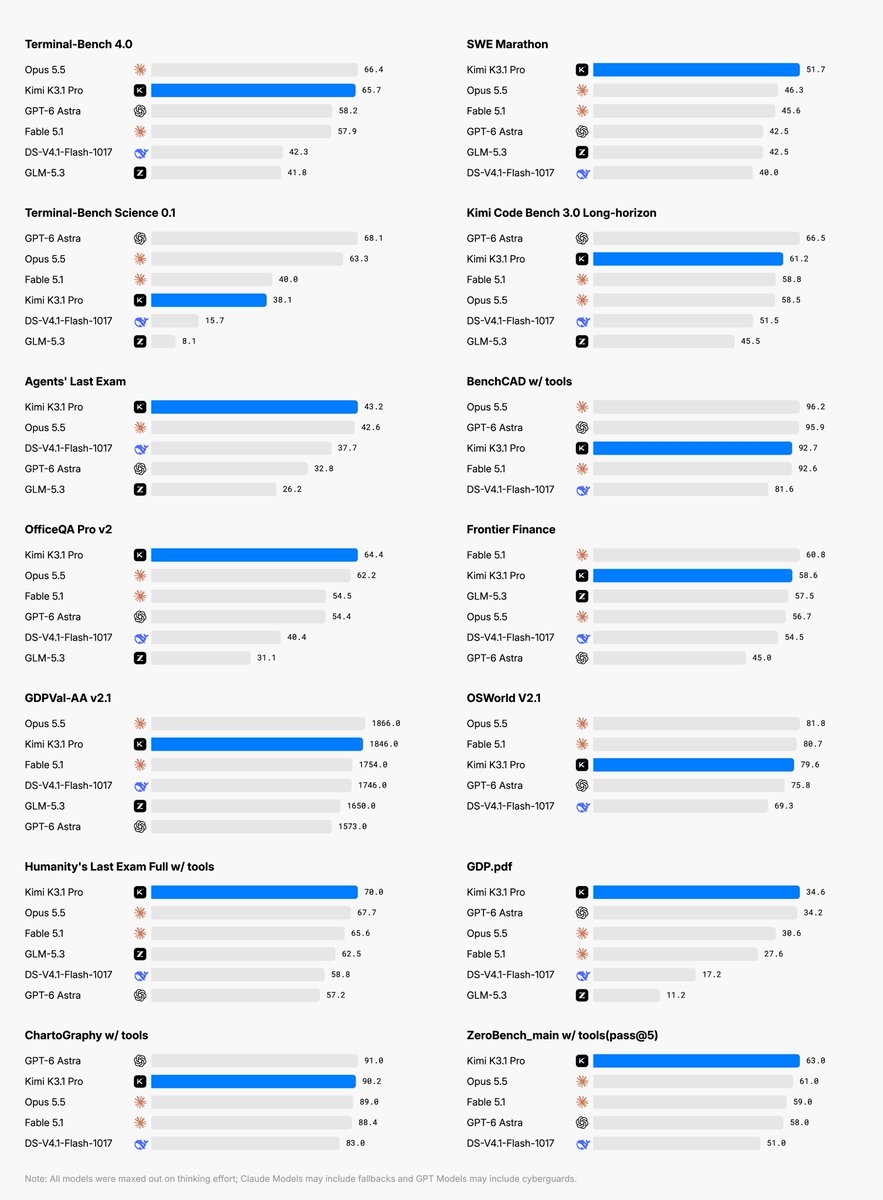
The benchmark figures are Kimi's own, and the blog says K3.1 Pro matches or approaches the strongest proprietary models. It says K3.1 Pro scores 65.7% on Terminal Bench 4.0, ahead of GPT 6 Astra at 58.2% and just behind Claude Opus 5.5 at 66.4%. In the chart attached to the post, K3.1 Pro leads the listed models on SWE Marathon, Agents' Last Exam, OfficeQA Pro v2 and Humanity's Last Exam with tools, and trails on Terminal Bench Science 0.1. The chart note says Claude models may include fallbacks and GPT models may include cyberguards. On Kimi's internal hallucination stress test, the blog says the claim level rate fell from 23.4% for K3 to 8.3%, and says that is not an everyday error rate.
On security, Kimi says it removed cyber related data from training for the open release. It reports that a checkpoint without that step solved 90.5% of its in house exploit tasks at pass at 3 and the final model solved 81.0%, and says its cyber capability remains behind that of frontier proprietary models that have been publicly available for at least three months. The Next Web notes the figures have not been independently checked.
What to expect next
Open weights are promised by November 4, 2026 but are not published yet, so the open weight label depends on that release and its license terms, which the sources reviewed do not state. None of the benchmark or security figures has been independently reproduced in the sources reviewed. Watch for the weights and license text, results on public leaderboards such as the Terminal Bench 4.0 board that Kimi cites, and outside testing of the hallucination and exploit claims.