Ethan Mollick highlights a study finding that AI agents are already flooding government services with inquiries

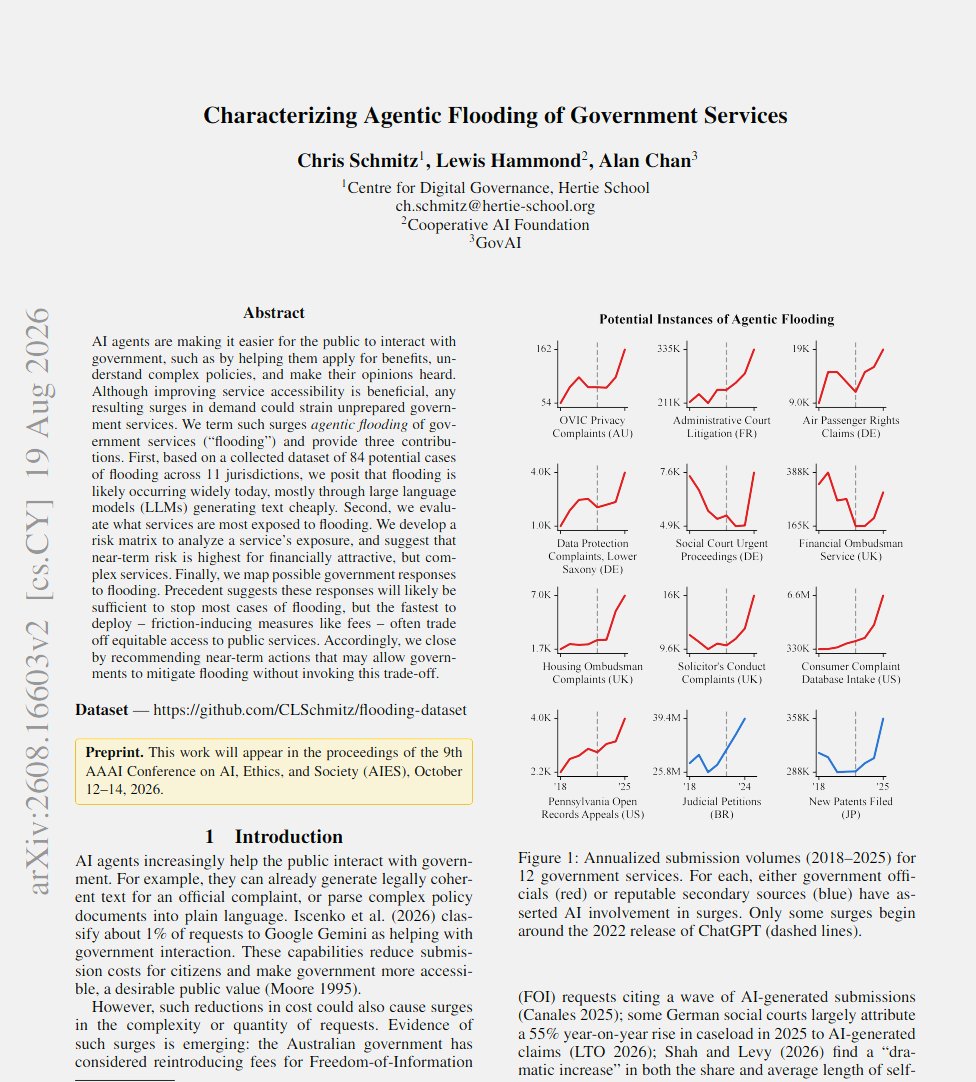
A consequential choice will be made soon by government and companies as they are increasingly flooded with agentic AI inquiries that overcome the frictions that gated access (see the graphs - it has already started!) Two options: do you make services worse or better as a result?


Context
If agents remove the effort that once limited requests, governments and companies must choose between adding friction and rebuilding services.
Mollick is sharing and commenting on a paper by other researchers. The paper collects reported cases and does not claim to prove that AI caused each rise in requests.
Deep dive
On October 17, Ethan Mollick wrote that a consequential choice will be made soon by governments and companies as they are increasingly flooded with agentic AI inquiries that overcome the frictions that gated access. Pointing to the graphs, he said it has already started, and asked whether they will make services worse or better as a result.
His images come from a paper by Chris Schmitz of the Hertie School, Lewis Hammond of the Cooperative AI Foundation and Alan Chan of the Centre for the Governance of AI, whose revised version was posted to arXiv on August 19. It collects 84 cases across 11 jurisdictions where government services saw rising volumes of requests, such as freedom of information requests and social court cases in Germany, that may involve AI. In 87% of cases the AI use was text generation by large language models, and in 69% officials themselves said AI was involved.
The paper's table sorts responses into two groups. Some suppress demand by adding friction or reducing the benefit, such as Australia considering fees for freedom of information requests. Others increase capacity by redesigning the service or deploying agents of their own. Mollick labeled the first group make it worse and the second make it better.
The authors say friction is quick to add but can hurt access for people with real needs. They recommend that governments audit their exposure, plan for digital identity and give legal certainty about AI made requests.
What to expect next
Watch whether more governments add fees, identity checks or other friction in response to AI made requests, and how courts and regulators judge those limits.
Also watch for governments deploying their own agents to handle requests, which the paper lists as the other path. As personal agents spread, companies with customer service and complaints systems may face the same choice Mollick describes.