Stanford's DeLM lets coding agents share progress instead of waiting on a lead agent

A new Stanford paper just proved that decentralized multi-agent systems can beat Claude Code and Codex on complex coding tasks, running up to 2.49× faster! DeLM tackles a key bottleneck in multi-agent systems: time wasted repeating work and waiting on other agents. DeLM replaces the central coordinating agent with a shared context and task queue. Agents pick up tasks independently, share discoveries as they happen, and build on each other’s progress. When one agent finds a solution or hits a dead end, the others can use that information immediately. DeLM beats state-of-the-art in both speed and accuracy on long-horizon tasks from Terminal-Bench 4.0, DeepSWE v1.1, and ProgramBench: - Up to 2.49× faster execution than the vanilla Claude Code and Codex baselines - Up to +19.2 percentage points in accuracy over the vanilla Claude Code and Codex baselines - Up to +19.9 points in ProgramBench test pass rate within the same 120-minute budget Built on Codex and Claude Code. Code and 720 trajectories are available so you can explore how the agents collaborate! An open-source plugin lets you try DeLM directly in Codex and Claude Code.



Context
Teams running several coding agents at once could finish faster and more accurately without a central orchestrator.
DeLM comes from Azalia Mirhoseini's Scaling Intelligence Lab at Stanford and runs on top of existing agent harnesses such as Codex and Claude Code. The authors report it was faster and more accurate than Codex, Claude Code, their native subagents and AOrchestra on long tasks from Terminal Bench 4.0, DeepSWE v1.1 and SWE bench Verified. The code is published on the project site.
Deep dive
The paper, by Yuzhen Mao, Jerry Gu, Aadi Chauhan, Qizheng Zhang, Hangoo Kang and Azalia Mirhoseini, targets what the authors call bubbles: time agents spend waiting on each other or redoing work a peer already did. Independent agents share nothing, agents that talk in rounds wait for each other, and under a main agent the lead blocks while its sub agents work.
DeLM removes the main agent. Agents claim tasks from a shared queue, publish compressed findings to a shared context as soon as they have them, and build on or correct one another's progress. Any agent can add work, and each submits its own full solution once its evidence covers the task.
The authors report accuracy gains of up to 17.5 points over the strongest baseline and speeds up to 2.49 times faster than the harness DeLM is built on. On ProgramBench, where agents rebuild programs from scratch, DeLM finished a 120 minute budget up to 19.9 points higher in test pass rate than Claude Code.
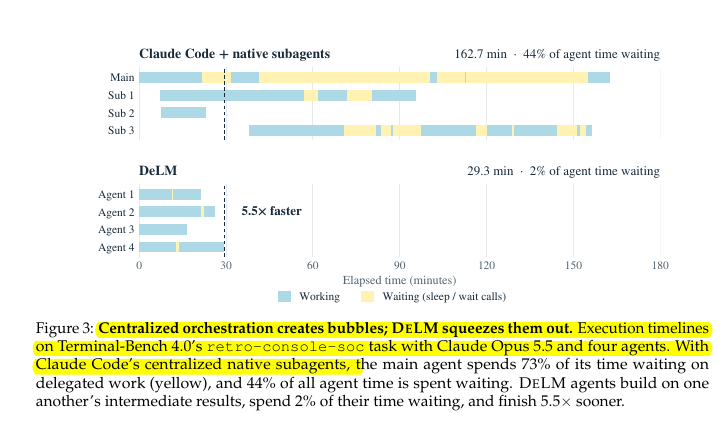
One figure shows the problem directly. On a Terminal Bench 4.0 task with Claude Opus 5.5 and four agents, the Claude Code main agent spent 73% of its time waiting, and 44% of all agent time was waiting. DeLM agents waited 2% of the time and finished 5.5 times sooner. Rohan Paul's post says code, 720 trajectories and a plugin for Codex and Claude Code are available.
What to expect next
The plugin means developers can try DeLM inside the coding agents they already use, so independent reports on speed and accuracy should follow. The results so far come from the authors.
Watch for whether OpenAI or Anthropic add shared context or task queue features to their own subagent systems, and for replications on other benchmarks. A key open question is how well decentralized agents handle conflicting edits on large real codebases.