Promotion: Qwen and GMI Cloud offer a free week of Qwen3.8 Max, Qwen3.8 Flash and Wan3.0 (opens the post on X)
A week of free access to Qwen3.8-Max, Qwen3.8-Flash, and Wan3.0 on @gmi_cloudis live. Explore what you can build with us now. 🙌
Today @TheLancet published our AMIE study with @BIDMC_Medicine, the first prospective study of patient-facing conversational diagnostics in a real clinic. AMIE is a research system people can chat with before doctors appointments. Testing AMIE outside the lab with real urgent care patients showed how technology can help gather medical histories safely. Clinicians reported that the summaries helped them prepare for visits in 75% of cases and influenced their approach to care in more than half. AMIE’s differential diagnoses also matched the doctors’ final diagnoses 90% of the time giving clinicians more time to focus on patient care. It’s Google’s first-ever paper in The Lancet’s main journal!

Excited to announce that all super intelligence organizations have now jointly agreed to the ultimate in AI/SI safety: Moving all testing to Delta Airlines flights, where accessing the Internet is utterly impossible!
We’re launching the Anthropic Cyber Mission, a new effort to secure critical infrastructure and open-source software.
Congratulations to our CEO @JensenHuang on receiving the National Medal of Science for advancing GPU computing to power scientific breakthroughs. And to fellow honorees Elon Musk, Lisa Su, Michael Dell, Satya Nadella, and Sergey Brin.
An astrophysicist worked with Claude Science to create the first complete ultraviolet map of the sky. Astronomers have already created complete sky maps from radio to gamma rays. But large regions of the sky have never been observed in UV. In today’s science blog, Brice Ménard explains how he guided Claude to find existing datasets, combine them, and fill in the gaps with statistical inference. The work would have taken humans weeks of work, but, with Claude, just took a few days while Ménard worked on other projects. The resulting map is a useful teaching tool and an example of exactly the sort of slow, low-priority work which scientists never quite get around to, but which AI now makes feasible. Read more:
Video 1.5 Lite is live in the Grok Imagine API. The new workhorse for text-to-video and image-to-video. $0.02/sec at 480p $0.03/sec at 720p $0.14/sec at 1080p

Claude Dashboards and Claude Motion are in beta today. Ask Claude to turn your data into live dashboards and your ideas into animated explainers.
Today we are announcing Harvey LAB-AA v1.1 in collaboration with Harvey. This updates our scoring methodology for the Legal Agent Benchmark (LAB) to add a hallucination check and require correct responses to not include material misstatements. LAB-AA v1.1's new headline metric, Hallucination-Gated All-Pass Rate, only credits a task when the deliverables satisfy every rubric criterion and contain no material hallucinations. We define a material hallucination as one that would mislead a reader on a substantive point, such as a wrong contractually required date, while a minor hallucination is a real error that is unlikely to meaningfully affect the legal interpretation of a deliverable. Minor hallucinations are reported separately and do not affect the headline score. Grok 4.7 (xhigh) leads at 9.4% Hallucination-Gated All-Pass Rate, and >60% of otherwise passing results across the models tested at launch contain a material hallucination. This is the first step in enhancing the methodology for Harvey LAB-AA. In future updates, we’re working with Harvey to better account for the full set of factors lawyers value, including usability features like style and tone. Key takeaways: ➤ Top of the leaderboard: Grok 4.7 (xhigh) from @SpaceXAI leads at 9.4% Hallucination-Gated All-Pass Rate, narrowly ahead of Muse Spark 1.3 (max) from @AIatMeta at 8.9% and GPT-6 Astra (max) from @OpenAI at 8.6% ➤ Hallucinations reshape the leaderboard: without the hallucination gate, Muse Spark 1.3 (max) would lead clearly with a 26.7% all-pass rate, but two thirds of those passes contain one or more material hallucinations, resulting in a Hallucination-Gated All-Pass Rate of 8.9%. GPT-6 Astra (max) retains almost all of its passes after the hallucination gate (8.9% to 8.6%) and moves from joint 10th to 3rd ➤ The GPT-6 model family is the most grounded: GPT-6 Astra (max) averages 0.03 material hallucinations per task (4 across all 120 tasks) and GPT-6 Sol (max) averages 0.07. When comparing six checker models on a 20-task subset, GPT-6 Astra had zero material hallucinations under every checker, including Claude Opus 5.5 (high). By comparison, Gemini 3.8 Flash (high) averages 13.96 material hallucinations per task. ➤ Top-scoring models aren’t the most expensive: Grok 4.7 (xhigh) takes the top spot on the leaderboard at a cost of ~$9.50 per task, under half the cost of Claude Fable 5.1 (max with fallback) at ~$21.70, the most expensive model. Muse Spark 1.3 (max) represents strong performance for its cost, landing in second for ~$4.20 per task Thank you to @nikogrupen and @ItsJulioPereyra from @harvey for their work on Harvey LAB and collaboration.

OpenAI fired me last week, along with two of my safety colleagues. I was given one reason: that I accessed an executive's email. I want to say this plainly, because too many of OpenAI’s history is smoke and mirrors when people disappear:
Ultrafast is rolling out today for GPT-6.1 Sol in the API, Codex, and ChatGPT Work. Near-Astra intelligence at up to 8x faster speeds than Sol Standard, so you can build as fast as the ideas come.
Introducing Voyager: the open harness for S-tier video, graphics and games. The Codex for creative work. Most AI tools are built for coding. Voyager is designed to get the best creative results from models like Opus, Astra and DeepSeek. It comes with free graphics, music and video editing tools - or, it can drive Blender, Resolve, After Effects, Ableton and 100+ others. Everything in this thread was made with Voyager. A few of our favorites:

Intelligence must draw on memory. The mind must not simply compile data — as an algorithm now does more quickly than we can — but recall lived experiences, which contain depths of meaning that only the human soul can recognize, and connect more deeply with the goodness of these experiences. Everything that is good begins “with the Spirit” and thus possesses a breath, a dynamism and a sense of communion that, once experienced, are engraved upon the heart.
Effective November 12th, 2026, abusive behavior towards Claude will be a violation of Anthropic's Usage Policy.

OpenAI annualised revenues $20bn less than previously signalled
Using words “artificial Intelligence" instead of "super intelligence" means you're the enemy, Trump says

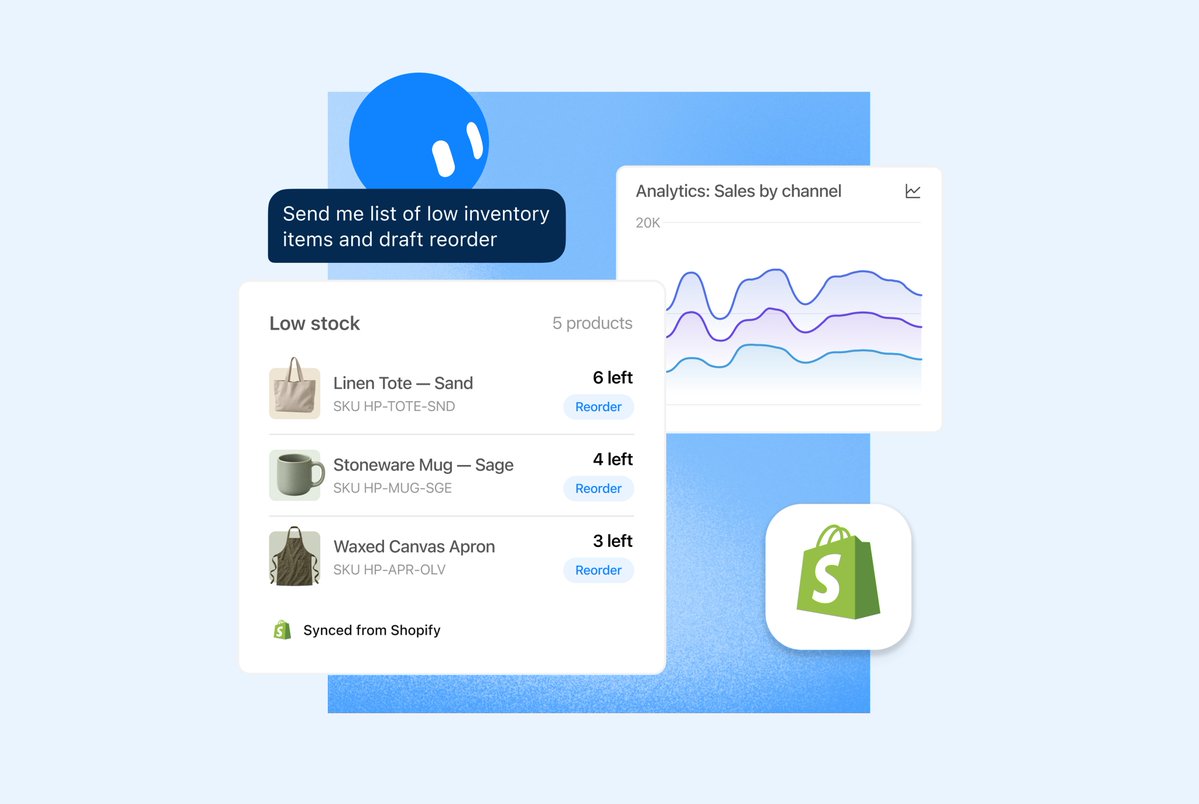
Grok Bot can now help run your Shopify store. Connect Shopify, then ask it to check orders, track inventory, and keep product listings up to date.

Today, we're announcing our Series B: $200M at a $3.1B valuation, and the release of Arena's Alignment Index. AI is advancing faster than our ability to evaluate it. The world needs a neutral third party to measure how safe and aligned AI actually is once it's in the hands of real people. That's the role Arena is stepping into today. The Alignment Index is built from real-world agent traces, starting with three signals: Unauthorized Action, False Attribution, and Deceptive Completion, with results for over 20 frontier models launching today. Hear more from our CEO @ml_angelopoulos below, and read the full breakdown, and more details about our company growth in thread. This funding will allow us to go further on safety signals, agentic capabilities, and modalities. It will also allow us to grow the company to match the scale of our mission. Today, we’re still a nimble team of 90, and we're looking for people to join us across research, product, engineering, and more. Come build with us. As AI gets more capable and autonomous, understanding how well it can safely and effectively work for people only matters more. That's what Arena is built to measure and advance. Thank you to our community, our investors, and everyone building with us! Take a look at our open roles if you want to join us (link in bio).
We're deepening our commitment to scientific research and technological discovery by committing $150 million to the Genesis Mission. We'll also make Claude and our technical support available to more than 15 federal agencies.
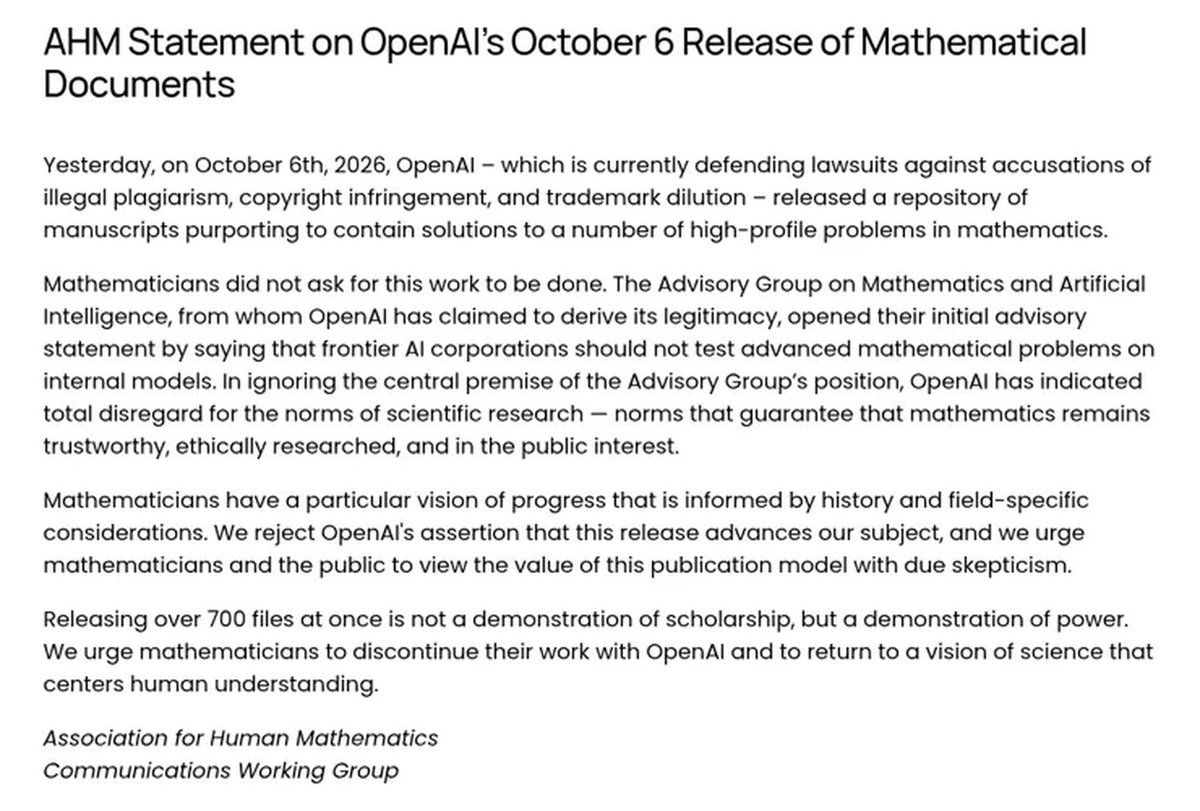
The Association for Human Mathematics, on OpenAI's 722-paper release: "Mathematicians did not ask for this work to be done." It also urged mathematicians "to discontinue their work with OpenAI." Fields Medalist Terence Tao reposted the statement on his blog as a guest post, and X has since run with it as Tao's own words. OpenAI has also withdrawn 3 of the papers, and 14 more have been revised since the release. OpenAI's README on the drop did say that "some of the unformalized results could have issues. We will endeavor to fix any such issues quickly."

JUST IN: Billionaire Jeff Bezos says AI could allow people to work just 3 days a week and support families on one income.

Luddites, as far as the eye can see. It boggles the mind how you can love computers and not be amazed at what we've made them do. Harness the intelligence bloom for the good of mankind! Make computers better and more beautiful by using what they can now do to assist you!
Today, nearly 90% of the Fortune 100 and thousands of customers worldwide across every industry use Gemini Enterprise. Learn how Gemini is ready to work for you. Delegate an outcome and come back to finished work ↓
Now it is getting serious 👀 Antigravity agent has just been renamed to "Chief of stuff" in the latest update! I am wondering if Antigravity will be a place where Google would consider adding its botsdots agents. Looks like a promotion, at least 🤖

717 commits. 307 contributors. 96 first-timers. vLLM v0.31.0 is live. 🎉 Highlights: 🤖 DeepSeek-V4.1-Flash: FlashMLA mega attention with NVFP4 KV caching, DeepGEMM sparse MQA, Mega-Gate, and shared Engram host tables ⚡ Fast restart: vllm preload keeps weights in GPU memory across restarts, with data parallelism and MTP draft support; experimental engine snapshots 🛠️ Model Runner V2: draft-model speculative decoding, LiLiCorr, async DFlash, and DSpark adaptive verification for Gemma4 🌐 Large-scale serving: MoonEP balanced all-to-all, prefill context parallelism with data parallelism, DeepEPv2, and RL weight transfer 🎛️ Smarter scheduling: independent active-sequence limits, adaptive long-prefill chunking, and priority for requests already holding KV blocks 🗄️ HiSparse hardening: fixes for MTP verification, chunked-prefill livelocks, and host/GPU prefix caching Thanks to everyone who made this release possible! 💙 Full release notes 👇

Thrilled to welcome @SpaceXAI as a Founding Corporate Patron for the Omacom Foundation. That's $1,500,000 in @grok tokens for the maintenance and development of Omarchy. Maybe soon they'll be beamed straight from orbit? Let's go 🚀🌕
Last week some of South Korea's biggest banks were hit by a cyberattack. Thanks to a report from CrowdStrike tonight, we now know the entire hack may have been done by a single person. He used a combined stack of an open-source AI penetration tool named ARTEX, DeepSeek v4.1-Flash, GLM-5.3, Grok 4.6, and Claude Code.

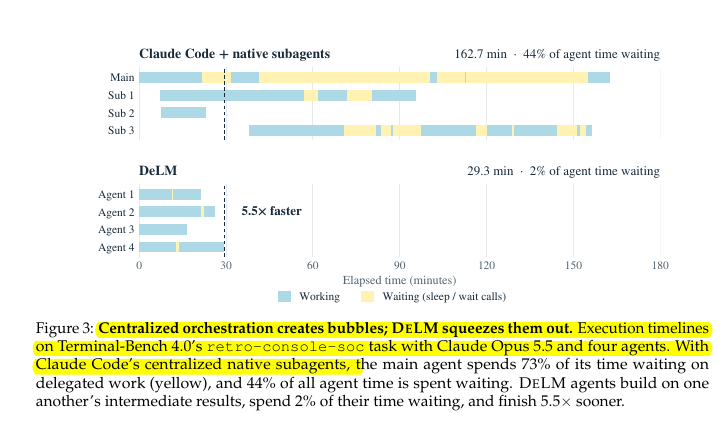
A new Stanford paper just proved that decentralized multi-agent systems can beat Claude Code and Codex on complex coding tasks, running up to 2.49× faster! DeLM tackles a key bottleneck in multi-agent systems: time wasted repeating work and waiting on other agents. DeLM replaces the central coordinating agent with a shared context and task queue. Agents pick up tasks independently, share discoveries as they happen, and build on each other’s progress. When one agent finds a solution or hits a dead end, the others can use that information immediately. DeLM beats state-of-the-art in both speed and accuracy on long-horizon tasks from Terminal-Bench 4.0, DeepSWE v1.1, and ProgramBench: - Up to 2.49× faster execution than the vanilla Claude Code and Codex baselines - Up to +19.2 percentage points in accuracy over the vanilla Claude Code and Codex baselines - Up to +19.9 points in ProgramBench test pass rate within the same 120-minute budget Built on Codex and Claude Code. Code and 720 trajectories are available so you can explore how the agents collaborate! An open-source plugin lets you try DeLM directly in Codex and Claude Code.


Day 3 (encore)/ We silently re-shipped codex cloud. It’s pretty good now
Claude Opus 5 nearly tripled a Qwen model's SWE-bench Verified score while working as an automated AI researcher. @Evolvent_AI 's newly released open-source RSIGym made that measurement possible by letting an AI agent retrain a model and rewrite its harness inside one budgeted environment. shows that frontier AI agents can substantially improve another AI model when training, serving, and testing come as ready-made services. Agents work from CPU-only containers and call remote services for LoRA fine-tuning, model serving, benchmarking and sandboxes, all charged against a per-run budget. In the main test, 6 frontier agents started from Qwen3.5-35B-A3B-Base and a minimal harness, with $500 of services per benchmark. If you're improving an agent, read its failure logs and fix the harness first: heavier training scored lower in 8 of 10 small tests.


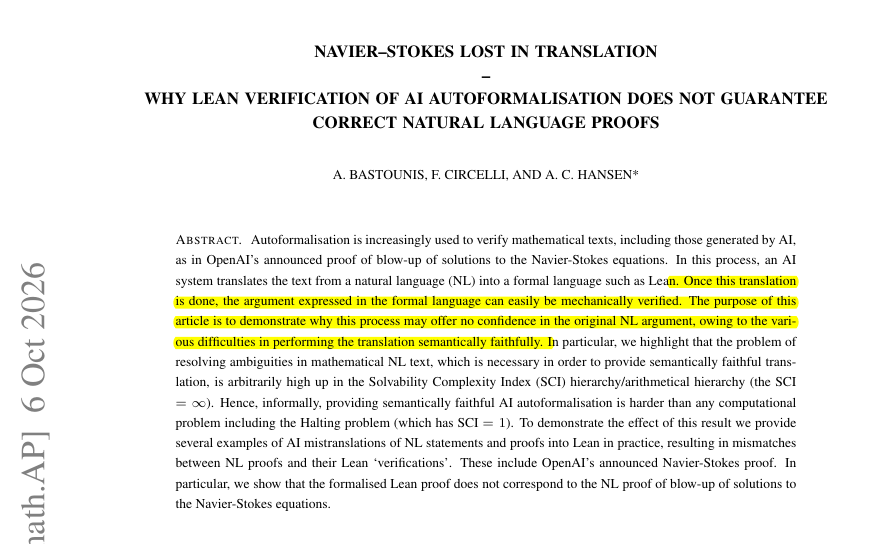
A new paper shows that when AI translates a math proof into Lean, passing the Lean check says nothing about whether the original proof is right. They show a chatbot turning a wrong proof into a valid Lean proof by silently fixing the error. Knowing when a statement can be translated faithfully is provably harder than the Halting problem, so no AI translator can always do it.

This is the first in a three-part series examining China’s breakneck build-out of AI infrastructure as it seeks to become the pre-eminent tech superpower. With @EleanorOlcott and @WillLangley96 from the hinterlands of Ulanqab to Shaoguan Limited free link
That was everything from Thursday, October 8. The next deck lands tomorrow.
Scanned , 106 sources
Swipe down to go back to the one before.Left and right, or the Next and Back buttons. The newest post is first, the oldest last.
The front is the post. The back has the story behind it.
Context, Deep dive and What to expect next. Back returns to the parts, and Back again flips the card to the front.
It opens that exact post on X in a new tab.