01Infrastructure
FT: Anthropic Pays $3.4 Billion for 1.7 GW of Gas Fired Generators to Power Its Data Centers (opens the post on X)

Anthropic strikes $3.4bn deal to generate gas-fired power for data centres
Anthropic strikes $3.4bn deal to generate gas-fired power for data centres
Trump says AI risks can be managed, signals openness to guardrails
Apollo’s planned $75 billion in AI chip purchases would eclipse the chip financing deals of every neocloud, putting the private equity giant behind only the major hyperscalers. Read more:
The Senate could vote as soon as this week on a bipartisan bill to speed up energy projects and make AI data centers pay their own way on the power grid. The Bipartisan American Affordability and Jobs Act would: Shorten environmental reviews for energy infrastructure, and the window to challenge projects in court Require data centers to pay for the electricity and grid upgrades they need, instead of passing costs on to other customers Make large data center developers put up money upfront in case a facility closes before new power projects are paid off It’s led by Sens. Shelley Moore Capito (R-WV), Sheldon Whitehouse (D-RI), Mike Lee (R-UT) and Martin Heinrich (D-NM).
BREAKING: US data center construction spending jumped +90% YoY in September, to a record annualized rate of $96.5 billion. This also marks the largest YoY increase in 10 years. This figure is now risen more than +60% YoY for 4 consecutive months. Since the start of 2024, data center construction spending has nearly quadrupled. Meanwhile, general office construction spending fell -8% YoY in September, to $46.0 billion, near its lowest level since January 2016. This brought the gap between data center and general office construction spending to a record $50.5 billion. Overall, US construction spending fell -1.9% MoM in September, its biggest monthly decline since April 2020. The AI infrastructure buildout is transforming the US economy.

DeepSeek, the Chinese AI disruptor, released striking adoption numbers for its AI agent infrastructure as it continues to challenge Anthropic and OpenAI with an entire swath of applications built around open-source AI technologies
NIKKEI: ELON MUSK’S TERAFAB HAS TOLD SEMICONDUCTOR EQUIPMENT SUPPLIERS IT IS TARGETING A PRODUCTION CAPACITY OF 1 MILLION WAFERS PER MONTH FROM 2032 ONWARD. OF THAT TOTAL, 700,000 WAFERS PER MONTH WOULD BE ALLOCATED TO MEMORY CHIPS AND 300,000 TO LOGIC CHIPS. WTF? 700kwpm for memory??
Exclusive: Amid a server shortage, Anthropic has been asking where to find 5 to 10 MW of power in older buildings, as demand revives interest in decades-old telecom facilities. Read more:
BREAKING: Bloomington, Indiana, unanimously votes to ban the use & deployment of superintelligent AI within city limits, citing “catastrophic risks.”
Suno is facing two more lawsuits over AI music clones.
Apple’s new CEO is pressing software chief Craig Federighi to take a more ambitious approach to AI, @MarkGurman writes in this week’s Power On.
An unreleased Anthropic model just helped solve a major quantum-computing question, per BI
Across our projects @GoogleDeepMind, we are witnessing a genuine phase transition in the pace of scientific discovery. You will see a glimpse of this in our releases in the next few weeks.
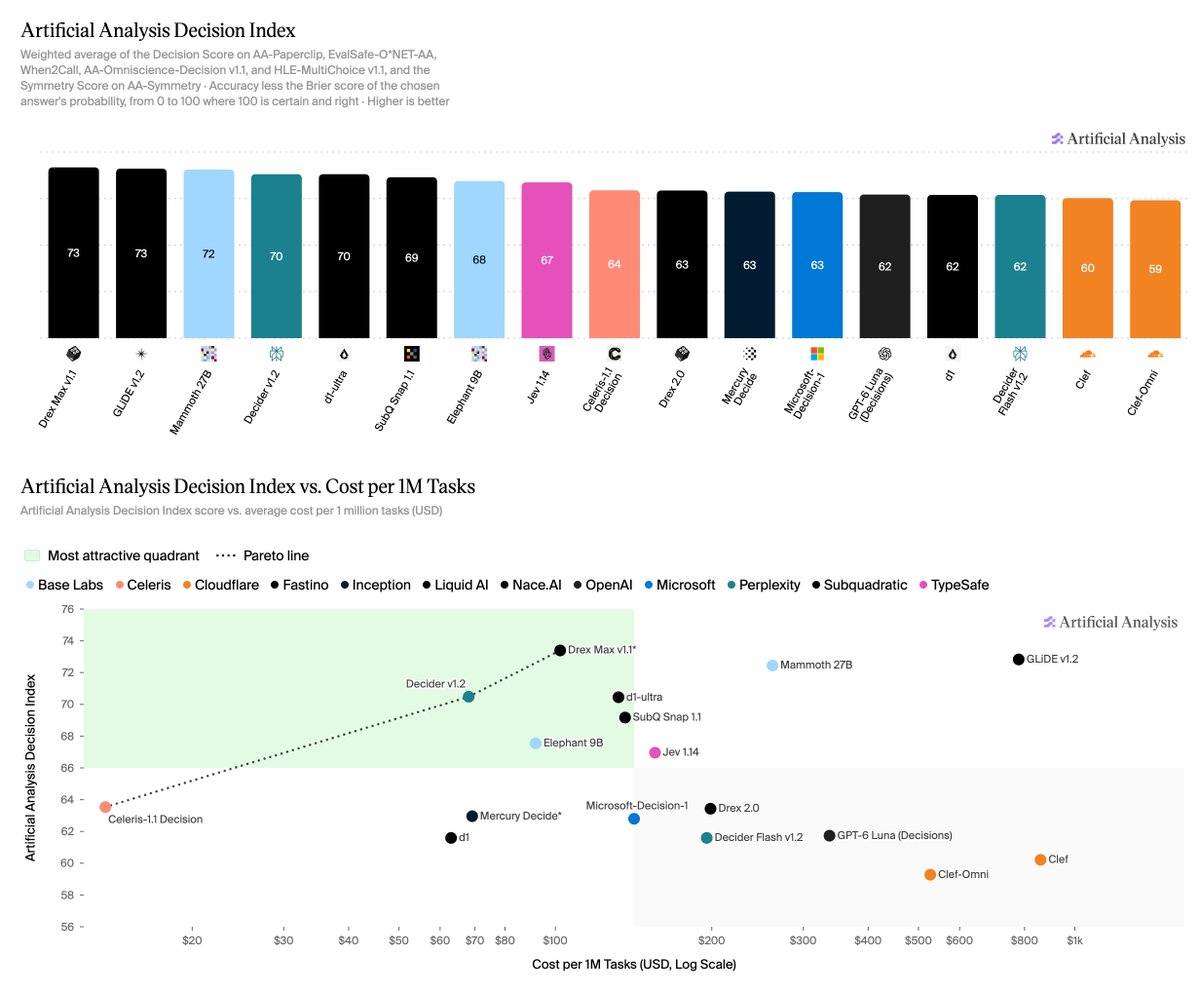
Introducing the Artificial Analysis Decision Index v2: a new proprietary evaluation, updated benchmarks, and a headline metric that rewards model calibration We’ve released the second version of the Artificial Analysis Decision Index to better reflect real-world utility and guard against benchmark gaming. 45% of the Index is now built on private datasets, up from 25% in v1. Drex Max v1.1 from @NaceAI narrowly leads among decision models at 73, within 1 point of GLiDE v1.2 (@fastinoAI) and Mammoth 27B (@baselabs) Updates in Decision Index v2: ➤ Decision Score: We adopt a new headline metric that rewards a model for both correctness and calibrated confidence. Each question scores from 0 to 100: right answers score above 50, wrong answers below 50, and confidence in its top answer moves the score within each half ➤ AA-Paperclip (30%): We added a new private benchmark of 1,500 documents including resumes, receipts, invoices, and AI and machine learning research papers. Models make decisions and extract facts from each document and are scored jointly as a single decision, correct only if all 15 answers are right ➤ AA-Symmetry (15%): This evaluates whether models change their answers for equivalent questions worded differently. We test 120 questions with variations such as reordered options, swapped labels, and negated yes/no questions, then measure how consistent the model’s probabilities are across those variations ➤ AA-Omniscience-Decision v1.1 and HLE-MultiChoice v1.1 (15% each, down from 25%): AA-Omniscience-Decision now varies the wording of its “I don’t know” option across ten alternatives. HLE-MultiChoice adds an option to decline using the same ten phrasings We’ve also added EvalSafe-ONET-AA (15%), our implementation of @typesafeai’s ONET benchmark. We have retained When2Call from @NVIDIAAI in the Index at a decreased weighting of 10% (down from 25%), and removed WildGuardTest given its high saturation Key results: ➤ Three decision models sit within 1 point at the top of the Index: Drex Max v1.1 from Nace AI and GLiDE v1.2 from Fastino Labs both score 73, with Mammoth 27B from Base Labs scoring 72 ➤ Cost per 1M Tasks varies by more than 60x across decision models: Celeris-1.1 Decision ($14), Decider v1.2 ($68) and Drex Max v1.1 ($102) sit on the Decision Index vs. Cost Pareto frontier, while Clef costs $859. Token price is not the only cost driver: most decision models, including Drex Max v1.1 and Decider v1.2, bill a document’s input once for all its questions, while GLiDE v1.2 and Decider Flash v1.2 bill it for every question. This means GLiDE v1.2 costs $780, nearly 8x higher than Drex Max v1.1 despite only 33% higher list prices ➤ Language models can score higher, alongside higher Cost and Time per Task: Claude Haiku 5.5 (Max) scores 77 and GPT-6 Luna (Max) scores 76 on Decision Index v2, putting them ~3 points ahead of Drex Max v1.1. GPT-6 Luna (Max) costs $1,530 per 1M Tasks vs. $102 for Drex Max v1.1 (15x the cost) and takes 11.34 seconds per task vs. 275 milliseconds (~40x slower)
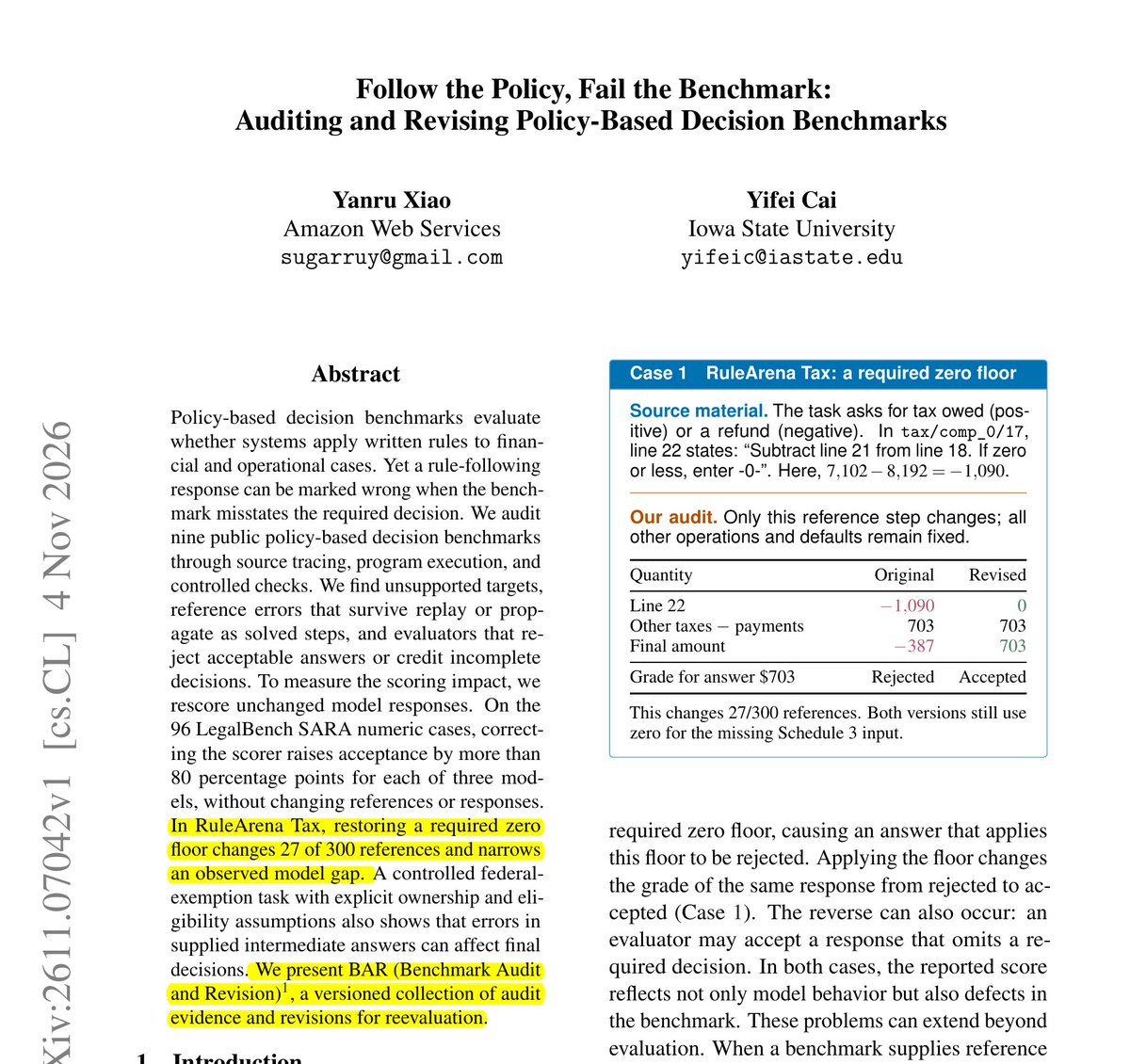
New Amazon paper finds that benchmarks used to grade AI models on tax, legal and business rules often mark correct answers wrong, because the tests’ own answer keys or grading code contain mistakes. Benchmarks like RuleArena and LegalBench test whether models apply written rules to tax, legal, and business cases. If the reference answer or the scorer is wrong, the score measures the benchmark's bugs, not the model. They audited 9 public benchmarks by tracing references back to the source rules, rerunning reference programs, and testing scorers with controlled answers. Then they rescored the same saved model responses after each fix. LegalBench's tax scorer deleted decimal points, so $259,487.13 was read as 25,948,713. Fixing it raised accepted answers from 8 or 9 to between 87 and 91 out of 96 for each of 3 models. Before trusting a low score on a rule-following benchmark, read the scorer code and check a few failed answers by hand.
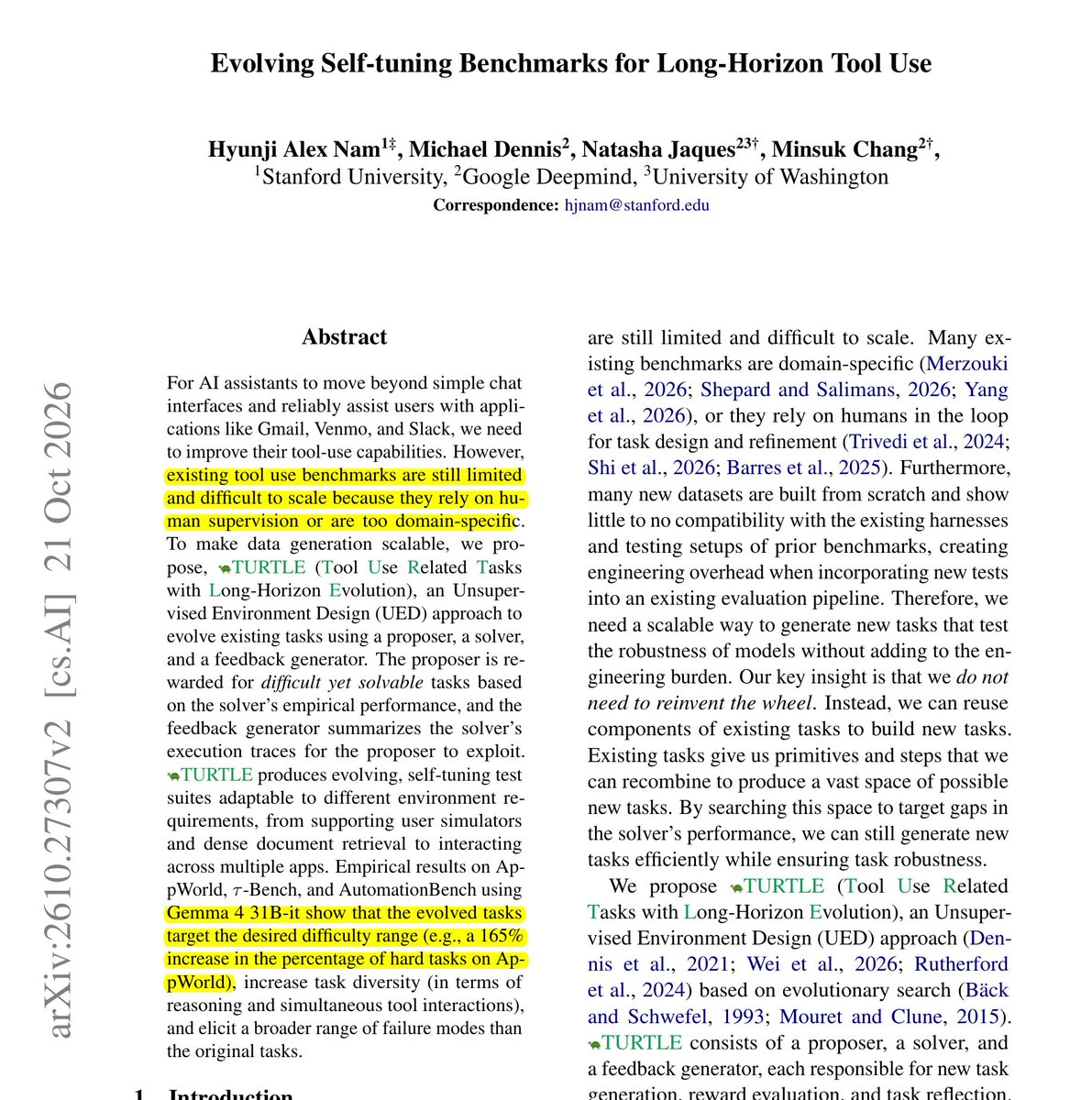
New Stanford and Google DeepMind paper shows that you can turn too-easy tool-use benchmarks into hard, still-solvable tests by evolving existing tasks against the model. Tool-use benchmarks like AppWorld are static, so models soon solve most tasks, and building new ones takes human work. TURTLE uses AlphaEvolve to mutate existing tasks, adding filters, extra steps and hidden lookups, then runs the solver model 10 times on each. Tasks score highest when the solver succeeds about 50% of the time, and each must be solved at least once. 69% of original AppWorld tasks were always solved by Gemma 4 31B-it, while nearly all 735 evolved tasks sat at 40% to 60% completion. An LLM judge rated 52.5% of evolved tasks hard, versus 19.8% of the originals. If your model aces a benchmark, evolve its tasks toward a 50% success rate instead of writing a new benchmark from scratch.
Exclusive: Brian Chesky is self-funding his AI lab for now, but the high cost of AI talent and chips could eventually push it toward outside money. Full story:
frontier models, with lots of test time compute, are becoming the engine of scientific discovery
We are building our first mobile app! 🐟 This is a new direction for Sakana AI, and we are looking for early beta testers to help shape it before we launch. If you are in Japan 🇯🇵 and want to try something early, sign up: t.co/wdZ2hvSX3n 🐡
Grok Bot fixes for improved token efficiency and smarter behavior are underway
Real robot. Real time. Uncut shot. Autonomous. Tomorrow.
Your feedback is on its way to Adam.
That was everything from Sunday, November 8. The next deck lands tomorrow.
Or follow along: on XAdd to home screen
Scanned