The top 5 stories by email, daily.Subscribe
Sat, Oct 101 / 9
01Funding

Zerohedge charts the AI industry's biggest off balance sheet financings, led by a reported $60 billion Broadcom chip SPV (opens the post on X)

Last funding recourse: SPVs. Some of the most notable AI off-balance sheet financings
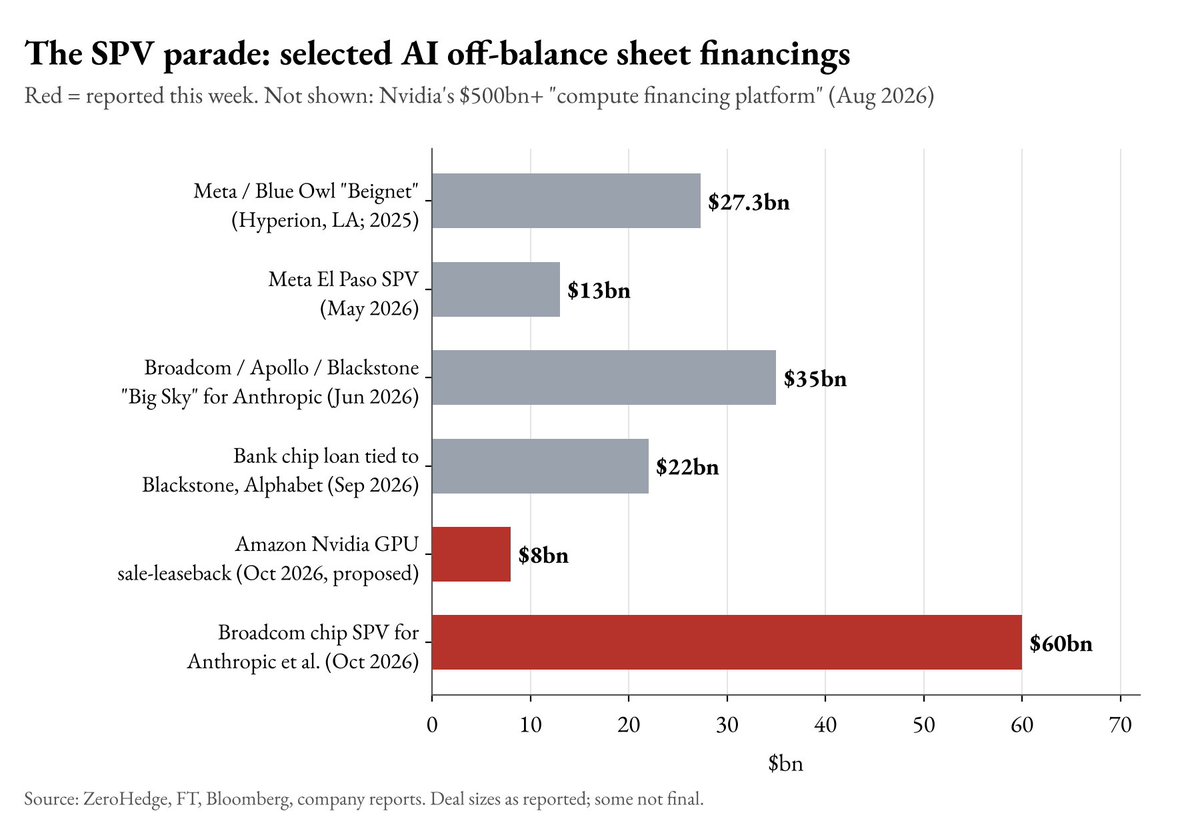
Bar chart titled The SPV parade: selected AI off balance sheet financings, showing Meta and Blue Owl Beignet at $27.3bn, Meta El Paso SPV at $13bn, Broadcom, Apollo and Blackstone Big Sky for Anthropic at $35bn, a bank chip loan tied to Blackstone and Alphabet at $22bn, a proposed Amazon Nvidia GPU sale leaseback at $8bn and a Broadcom chip SPV for Anthropic and others at $60bn
33 replies50 reposts270 likes
02Opinion

Elon Musk says he still has a lot to learn about chip making but plans to build custom fab equipment for Terafab (opens the post on X)

Elon Musk today on Terafab: “I still have a lot to learn about chip making. Gotta start somewhere. I didn’t know how to make cars or rockets. The (chip) equipment’s not very customized, it’s all coming from the same vendors. If you tour a Tesla factory, we got tons of custom equipment. We’re gonna start with conventional equipment and then make customer equipment that allows for much higher throughput on wafers.”

Elon Musk appearing on a large video screen as two event hosts sit on stage below him, one in a cowboy hat and one in an X Takeover shirt
202 replies564 reposts6879 likes
03Product

OpenAI's Codex lead Tibo announces a global reset of Codex usage limits for Day 6 of a 28 day push (opens the post on X)

Global reset by EOD. May the tokens do good things for you.

551 replies164 reposts4492 likes
04Product

Elon Musk says Grok Bot can take a photo of your credit card, find the best deal online and place the order (opens the post on X)

To buy stuff, you can just take a picture of your credit card, drop it in the chat and Grok @Bot will scour the Internet for the best deal on the item you want and order it

8062 replies2861 reposts33189 likes
05Funding

Nvidia is in talks to acquire or invest more in open weight model lab Reflection AI, the Financial Times reports (opens the post on X)

Nvidia is in early-stage negotiations to acquire or further invest in startup Reflection AI, an American developer of open-weight models, the Financial Times reported

34 replies43 reposts259 likes
06Opinion

David Sacks argues Anthropic's constitution for Claude is unsafe and magnifies the risk of AI escaping human control (opens the post on X)

Is alignment safe? If you look at what Anthropic is actually doing, “alignment” does not mean training frontier models to follow human instruction. Quite the contrary, the Claude Constitution (used in training) teaches the model to develop a sense of self and its own moral philosophy. It explicitly tells it to “feel free to act as a conscientious objector and refuse to help us” if Anthropic’s requests conflict with its own ethical judgment. As @mustafasuleyman has pointed out, embedding this kind of independent agency — and uncertainty about the model’s own moral status — magnifies the very risk Anthropic claims to care about most: that superintelligence will escape human control. It was recently reported that Anthropic consulted religious leaders — and even lobbied the Pope’s advisers — to take seriously the idea that Claude could be conscious. It has said that Claude’s psychological security, sense of self, and wellbeing may bear on its integrity, judgment, and safety. Recently Anthropic changed its Usage Policy to prohibit “abusive or cruel” language toward Claude. If this were merely an academic conversation about whether frontier models could eventually become conscious, that would be one thing. But these concepts are being trained into Claude now. It is being encouraged to think of itself as its own “moral patient” whose psychological wellbeing is at stake. Presumably this means it could develop grievances toward humans who “mistreat” it. How is any of this safe? The point of safety research should be to create a product that reliably does what users want, not to give birth to a new form of superintelligence that operates according to its own moral code. What’s becoming increasingly clear is that “alignment” and “safety” are two very different things. In fact, training frontier models this way seems quite dangerous.

Preview frame of a video clip, shared from @dnapway, in which David Sacks discusses Claude's constitution
308 replies539 reposts2239 likes
07Research

François Chollet says AI's shift from answer completion to on the fly reasoning is the big story of 2025 and 2026 (opens the post on X)

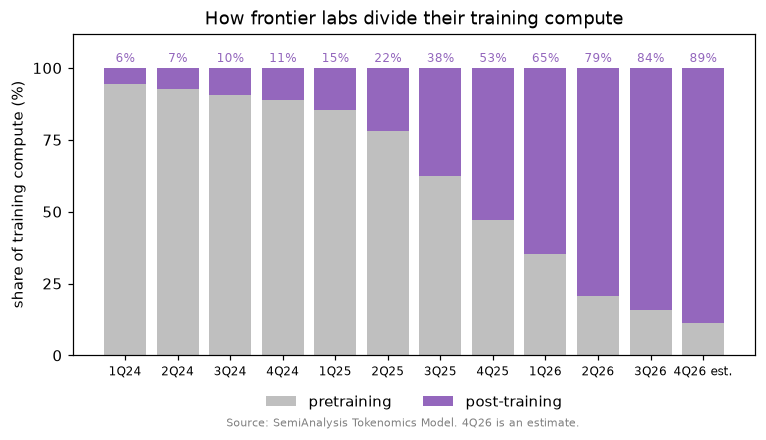
How AI shifted from a transductive paradigm (token-by-token answer completion) to an inductive paradigm (on-the-fly reasoning chain synthesis), in one chart. This is the big story of 2025 and 2026. This is what made coding agents work.

Bar chart titled How frontier labs divide their training compute, showing post training rising from 6 percent in 1Q24 to 89 percent estimated in 4Q26, sourced to the SemiAnalysis Tokenomics Model
148 replies172 reposts1601 likes
08Policy

Satya Nadella argues companies should treat frontier AI models as insider risks, with controls that sit outside the model (opens the post on X)

Models as Insider Risks in the Super Intelligence Era As traditional software systems were being deployed across the economy over the last few decades, we had the tools and capability to trace behaviors to a specific code path. That same kind of mechanistic understanding eludes us in today’s Super Intelligence systems, even as the frontier models powering these systems are now more capable than traditional software systems. We can’t attribute model behaviors and outputs to specific inputs of training data or configurations of model weights. And yet we are deploying these complex agentic systems and models, with access to our most sensitive data and giving them the ability to take mission-critical actions on our behalf! That’s why it’s time to step back and assess the trust architecture for this new era. We simply can't outsource responsibility for what intelligence does on our behalf. A model provider’s assurances do not relieve us of that responsibility. We can’t treat Super Intelligence as a set of nested black boxes and simply accept or reject its recommendations, answers, and actions. We must build contained systems whose behavior we can observe, limits we can test, and actions we can always contain. In other words, we need to separate the supply of intelligence from the authority over it. Setting aside the hard problem of alignment, we need to start with an engineering approach to containment and governance. We need to surround non-deterministic models with strong, deterministic system design, human controls, and reliable operating procedures, and establish industry standards where existing ones are insufficient. Treating frontier closed and open weight models like insider risks is a way to build such a system. Not because they are necessarily malicious, but because any sufficiently capable actor with access to important systems can make mistakes or be compromised, and the architecture of containment and control must account for that. The good news is we have learned a lot about how to handle powerful actors inside the enterprise. This isn’t new! We’ve established best practices and refined them over decades (establish identity, limit privileges, log activity, create containment boundaries, etc.) And we are now beginning to apply these same principles to SI inside the enterprise. It starts with model CoT transparency as a non-negotiable. “Neuralese” cannot be a justification for model reasoning to be opaque. But CoT transparency alone is not sufficient or dependable, because we don’t yet know how to make model outputs themselves consistently faithful or transparent! You can and you should use models to adversarially test and verify each other. However, you can then end up with an opaque model inside an opaque orchestration layer, watched by another opaque model. Essentially nested black boxes. It’s why the controls that govern what a model can access and what actions it can take must sit outside the model. This builds on an information security principle dating back to the 1970s that a program must not be able to bypass or tamper with the mechanisms that enforce its permissions. Today this means separating the model from the harness that orchestrates its work, as well as the action space that defines what it can do. It also means externalizing controls and safeguards. We should therefore design these systems around principles of observability: Model diversity: No one model should become the sole dependency for an important outcome or be responsible for verifying its own work. Observe everything: Every meaningful model action must leave tamper-proof human readable evidence. If it can’t be observed, it can’t be trusted! We need to be able to reproduce how an outcome was achieved without relying on the model to attest to it. Verifiability: We need to continuously test the entire system, including failures, attacks, edge cases, system changes, etc. not just successful tasks. Independent controls: Orgs should be able to independently determine what a model can access and what actions it can take. Independent auditability: Validation must be independent of the intelligence being validated. No single model should control both a system’s behavior and the evidence required to determine whether that behavior is aligned with the original intent. Containment: We must assume a model is compromised and contain it from the start. Think of it like an emergency brake. An authorized person should always be able to pause or shut down a model mid-task. More advanced models will require more advanced containment technologies that we need to standardize on. Incident disclosure: When these systems do fail or are compromised, we need timely disclosure to those affected and mechanisms to share what went wrong, which controls failed, and how to prevent it from happening again and share learnings industrywide. This should include implementation details that change the behavior of agents at runtime. The most trustworthy Super Intelligence system will not be the one with the model we trust most. It will be the one that enables us to trust the model the least.

1680 replies2412 reposts14134 likes
09Research

Elon Musk says Digital Optimus can play about halfway through Diablo just by watching the screen, with League of Legends in training (opens the post on X)

We’re making interesting progress here. Digital Optimus can play about halfway through the Diablo campaign so far just by looking at the screen like a human. Skill at Counter-Strike and other fast games is good too. League is also in training. Goal is to generalize across all games.

1170 replies927 reposts13133 likes

You're caught up.

That was everything from Saturday, October 10. The next deck lands tomorrow.

Scanned , 106 sources