Tencent Open Sources Hy MT3 Translation Models, Expanding Coverage From 38 to 102 Languages

🚀 Hy MT3 is here — third-generation open-source translation models. More accurate, more complete, and better at following user instructions. Language coverage expanded from 38 to 102. Optimized for game localization (with Honor of Kings) and image/OCR translation. Models open for download and deployment. 🤗 t.co/MMRiRTbI3j 🔗 t.co/eHJbBrohzm 📚:
Context
Developers get free, downloadable translation models as small as 1.8B parameters that Tencent says rival far larger systems, which could make high quality translation cheaper to run on their own hardware.
Hy MT is Tencent's family of open translation models; the previous generation, Hy MT2, covered 38 languages and was released in May. Hy MT3 comes in three sizes, 1.8B, 7B and a 30B mixture of experts model with about 3B active parameters, with quantized versions for llama.cpp. Tencent also released TransRubric, a rubric based tool for scoring translations automatically.
Deep dive
Tencent released Hy MT3 on November 24, the third generation of its open translation models. The weights for all three sizes, 1.8B, 7B and a 30B mixture of experts model that activates about 3B parameters per token, are available on Hugging Face and ModelScope, along with FP8 and GGUF versions for cheaper local use.
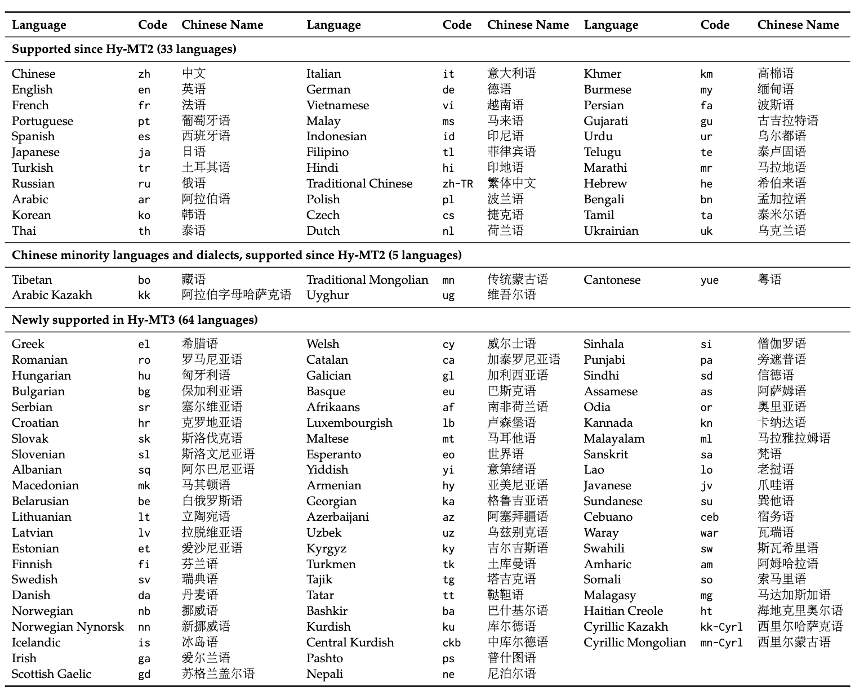
Language coverage grows from 38 to 102. Tencent lists 33 languages and 5 Chinese minority languages carried over from Hy MT2, plus 64 new ones ranging from Greek and Welsh to Swahili and Icelandic.
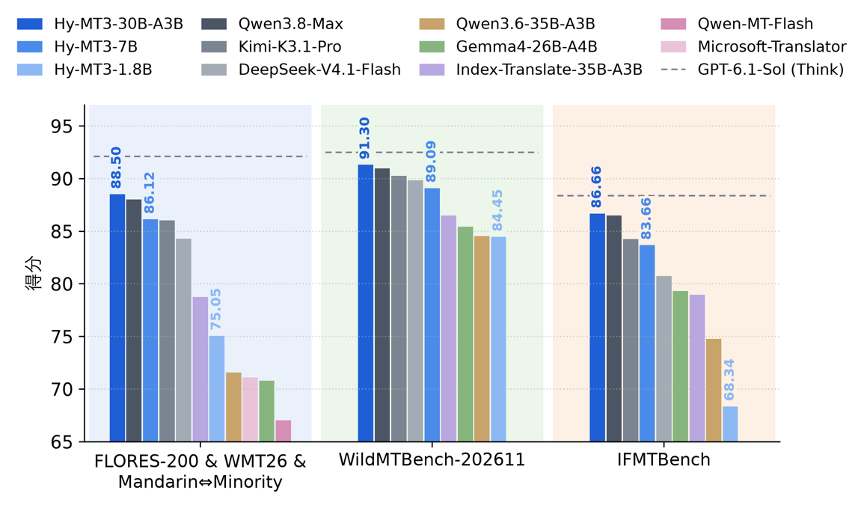
Tencent says that compared with Hy MT2, on real world data the share of outputs with mistranslations fell by 43 percent, omissions or additions by 74 percent and instruction following errors by 40 percent. It claims the 30B model has the best overall results among the models it tested without thinking mode, ahead of Qwen3.8 Max, Kimi K3.1 Pro and DeepSeek V4.1 Flash, and comes close to GPT 6.1 Sol and Gemini 4 Argon in thinking mode. Its own chart still shows GPT 6.1 Sol ahead on all three benchmarks. These are company results, scored partly with Tencent's own TransRubric tool, and have not been checked independently.
The release is also tuned for two industrial uses: game localization, built with the Honor of Kings team, and translating text in images after OCR. Tencent also open sourced TransRubric, which it says beats other automatic scoring methods on the WMT26 metrics task.
What to expect next
Watch for independent tests on public benchmarks such as FLORES and WMT, especially for the 64 newly added languages, where training data is usually thinner. Community ports and quantized builds will show how well the 1.8B and 7B models run on laptops and phones. Another question is whether other labs adopt TransRubric for scoring, since several of Tencent's own headline numbers depend on it.