Ant Ling Releases LingSante Pulse, an Open Weight Foundation Model for Body Signals

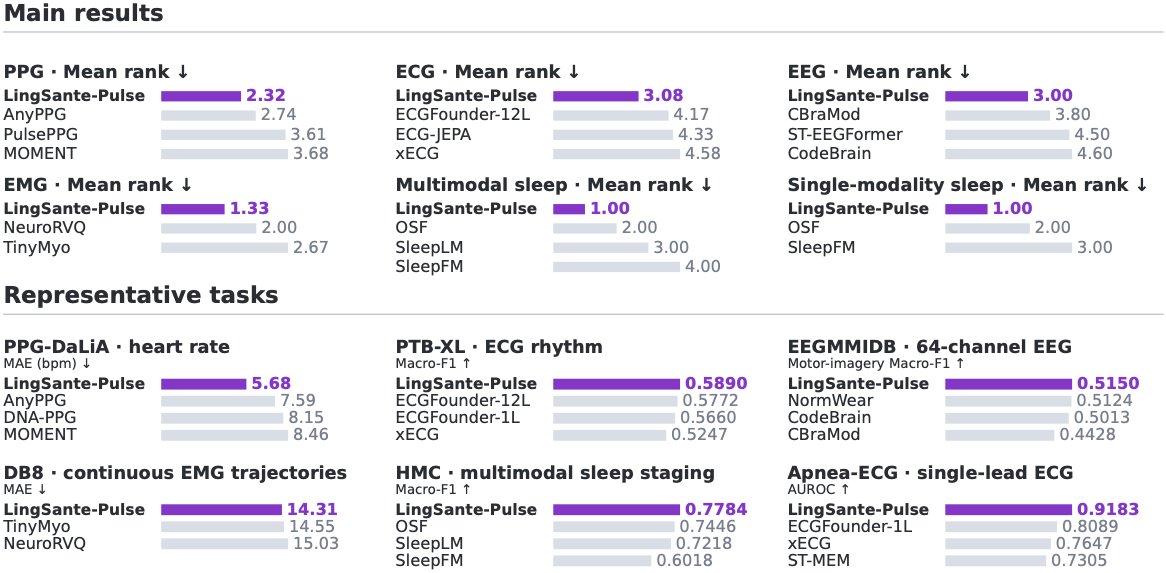
Introducing LingSante-Pulse, an open-weight, general-purpose physiological foundation model. One frozen encoder supports multimodal and single-sensor use, with the best dataset-balanced mean rank across four signal domains in 38 task configurations.
Context
One frozen encoder that transfers across heart, brain, pulse and muscle signals could make health sensing models cheaper to build for wearables and clinics.
Ant Ling, from Ant Group's AGI initiative, released LingSante Pulse as an open weight physiological foundation model on the same day as Ling 3.2 Air. The account says one frozen encoder supports both multimodal and single sensor use across four signal domains.
Deep dive
Ant Ling introduced LingSante Pulse, an open weight, general purpose physiological foundation model. According to the post, one frozen encoder supports multimodal and single sensor use, and the model has the best dataset balanced mean rank across four signal domains in 38 task configurations.
In follow up posts in the thread, Ant Ling described the design. A shared encoder processes each physiological channel independently. Cross modal alignment, random feature prediction and masked reconstruction teach the model relationships between signals while keeping information within each signal.
The account said the frozen backbone transfers across ECG, EEG, PPG and EMG, which cover heart, brain, pulse and muscle signals. It reported 25.1% lower heart rate error on PPG DaLiA than AnyPPG, a Macro F1 of 0.5890 on PTB XL rhythm classification, and 0.6186 on EEGMAT mental arithmetic. These are Ant Ling's own results.
The post drew about 342,000 views at scan time, though likes and reposts were far lower than for Ant Ling's Ling 3.2 Air release the same day.
Ant Ling is the model series from Ant Group's AGI initiative, which also publishes the Ring reasoning and Ming any to any models.
What to expect next
Watch for independent tests of LingSante Pulse on clinical and wearable datasets, and whether health device makers adopt it. Open questions include licensing terms for medical use, how it handles data from consumer sensors versus hospital equipment, and whether Ant Group builds it into its own health products. Peer reviewed publication of the results would also make the claims easier to check.