Mustafa Suleyman Publishes a Microsoft Pretraining Number on OpenAI's Held Out Set

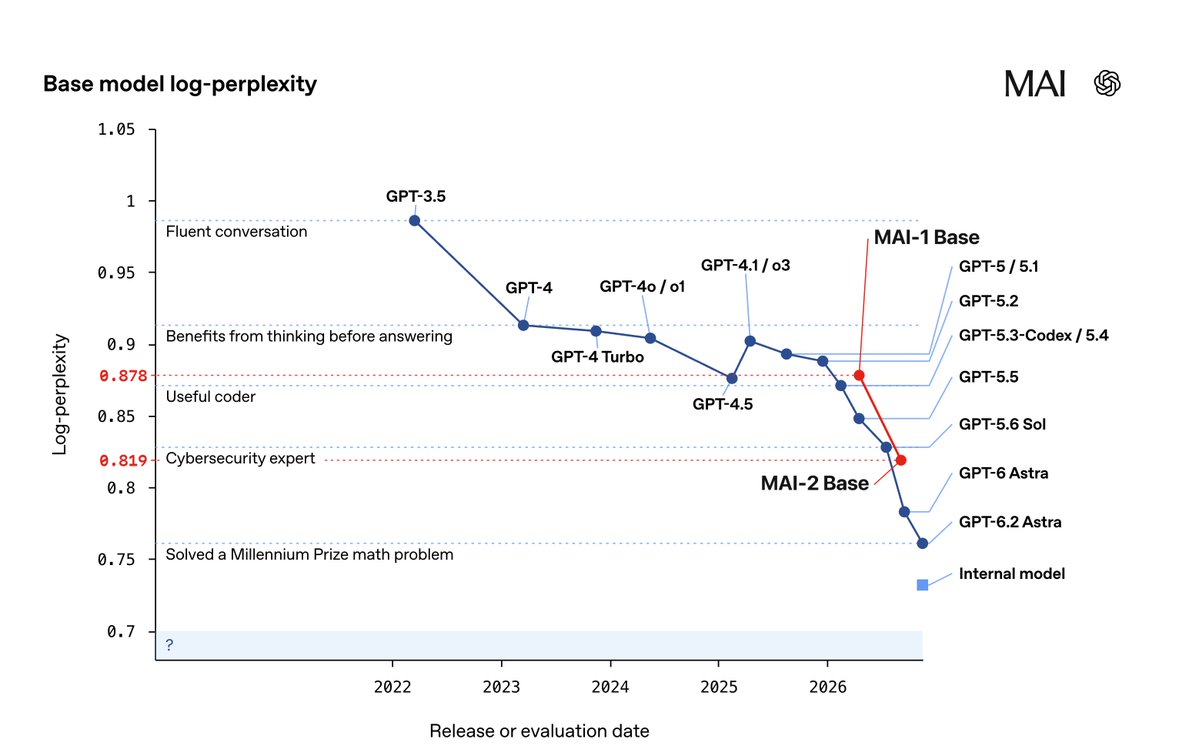
We fully support OpenAI's transparency initiative. Thanks to @merettm @markchen90 @gdb @sama for leading the way. We all got into this field to build safe AGI that is genuinely good for humanity. One of the hardest parts of AI safety is coordination, and this is a step in the right direction. Many more steps like this will be needed to deliver safe, contained, and aligned AGI in the next few years. We're committed to sharing our pre-training progress on a common held-out evaluation set. With OpenAI's permission, we report MAI-2 Base on their evaluation set. Its log-perplexity is 0.819, putting it in the same ballpark as the GPT-5.6 Sol base model. Our model uses the same tokenizer as OpenAI, so the numbers are directly comparable. In the future, to be able to compare across labs we might need to report bits-per-byte (BPB) rather than perplexity since different labs use different tokenizers. We will also need different evaluation datasets - the fact we have access to OpenAI's evaluation dataset is a special case. Safety and alignment is now the mission. It's the absolute number one most important focus for our industry. And it begins with small, practical steps like these towards better coordination on pacing.
Context
OpenAI asked other labs to make pretraining progress comparable. On the same day, the head of Microsoft AI posted an official number on OpenAI's own held out set, and said the company is committed to sharing more.
Late Sunday, Mustafa Suleyman, chief of Microsoft AI, quoted the OpenAI essay and said his lab fully supports the transparency initiative. He went further than a thank you. With OpenAI's permission, he reported that Microsoft's MAI 2 Base model scored 0.819 log perplexity on OpenAI's evaluation set, in the same ballpark as the GPT 5.6 Sol base model. He said the two models use the same tokenizer, so the numbers are directly comparable. He also said Microsoft is committed to sharing pretraining progress on a common held out set.
Deep dive
The post is official first party reporting, not a leak and not an aggregator summary. Suleyman thanked Jakub Pachocki, Mark Chen, Greg Brockman, and Sam Altman, then published a concrete figure: MAI 2 Base at 0.819 log perplexity on OpenAI's held out set. He placed that result near OpenAI's GPT 5.6 Sol base model and said the comparison works because both sides used the same tokenizer. That is the first public answer from another frontier lab on the exact measurement OpenAI put forward earlier in the day.
He was also careful about what the number cannot do. He said that in the future, labs may need to report bits per byte rather than perplexity, because different labs use different tokenizers, and that they will also need different evaluation datasets. Access to OpenAI's set, he wrote, is a special case. The broader claim is about pacing and coordination: safety and alignment is now the mission, and it begins with small practical steps toward better coordination.
This is a single official data point, not a shared industry protocol. Microsoft did not publish a full loss curve, a training recipe, or an independent audit, and the GPT 5.6 Sol comparison is Suleyman's statement, not a joint report. Still, a named Microsoft base model on OpenAI's own held out set, posted by the lab's chief, is a real move toward the common yardstick OpenAI asked for.
What to expect next
Watch whether Microsoft posts a fuller pretraining curve, whether OpenAI confirms the comparison, and whether other labs publish numbers on the same set or switch to bits per byte. The test is repeated, comparable releases, not one Sunday post. If later official models arrive with no numbers and no shared set, this will have been a one off gesture. A joint statement on a shared set would be stronger still.