OpenAI's Codex Lead Says the Team Might Have Fixed the 'Model at Capacity' Errors

Codex team might have actually fixed the "model at capacity" errors that have been pestering you.
Context
Capacity errors have been one of the most common complaints from heavy Codex users, so a fix makes OpenAI's coding agent more dependable as it competes with Claude Code.
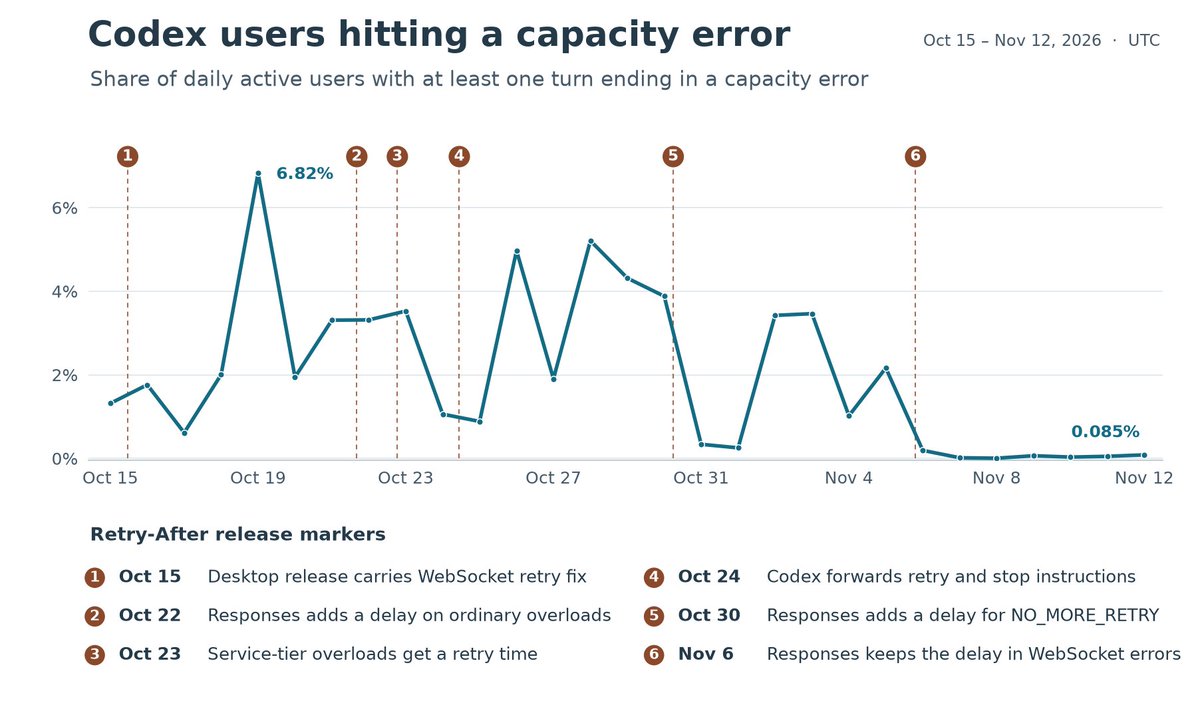
Thibault Sottiaux, who leads OpenAI's Codex team and posts as Tibo, shared the update just before 1 AM ET on November 16 with a chart of error rates. The chart shows the problem peaking in mid October.
Deep dive
The chart in the post, titled Codex users hitting a capacity error, tracks the share of daily active users with at least one turn ending in a capacity error from October 15 to November 12. It peaks at 6.82 percent around October 19 and falls to 0.085 percent by November 12.
Numbered markers on the chart tie the decline to a series of releases. They include a WebSocket retry fix in the desktop release on October 21, responses that add a delay on ordinary overloads on October 22, a retry time for service tier overloads on October 23, Codex forwarding retry and stop instructions on October 24, a delay for a no more retry signal on October 30, and responses keeping the delay in WebSocket retries on November 6. In other words, much of the improvement shown comes from Codex waiting and retrying automatically instead of failing a turn.
Sottiaux hedged with the words might have actually fixed, and the post drew more than 1,900 replies, many from users describing their own experience. The chart reflects OpenAI's own data and has not been independently checked.
What to expect next
Watch whether the error rate stays near zero as usage grows, especially after new model releases that tend to bring traffic spikes. Users will also look for usage limits and resets to stay stable. If reliability holds, OpenAI can push Codex harder into teams that need predictable agent runs, where outages have been a reason to switch tools. Watch too whether rivals such as Claude Code publish similar reliability numbers.