Rohan Paul: WisprFlow Hires Founding Alexa Scientist Ariya Rastrow and Moves to Speech Models It Trains Itself

The keyboard was a workaround for machines that couldn’t hear. Machines that hear make it optional. WisprFlow recently hired Ariya Rastrow (founding Alexa scientist) as chief science officer and moved from rented speech engines to models it trains itself. Hard to find a better fit for a speech lab than someone who scaled Alexa’s speech team. Canto 1, his lab’s first model, was built to cut how often people edit dictated text, so Wispr trained it on noisy real-world dictations and tuned it to each user’s vocabulary and names. And this is a hard test, unlike many, because Speech recognition was long tested on clean, read-aloud audio, but the hard problem is a cheap laptop mic in a room where someone else is talking. On about 10 hours of real Flow dictations from more than 2,300 speakers, it posted a 3.4% word error rate, lower than all competing models that Wispr tested. Typing gives you feedback on every keystroke, while speech makes you wait until the end of a sentence to see what the machine heard, so speed counts as much as accuracy. Since launch, dictations that take more than 1 second to appear are down 54%. Its training runs through pretraining, supervised fine-tuning and reinforcement learning with GRPO, the same stages used for large language models. The reinforcement learning stage uses corrections from Flow users who opted in to share data. When someone fixes a dictated word, Wispr checks how the audio aligns with the text and how the edit is shaped. A misheard word gets folded back into the training reference, and a plain rewrite of the sentence gets ignored.

Context
A dictation startup replacing rented speech engines with its own model, trained on real noisy audio and user corrections, shows how voice apps are trying to own the model layer to beat Big Tech assistants on accuracy.
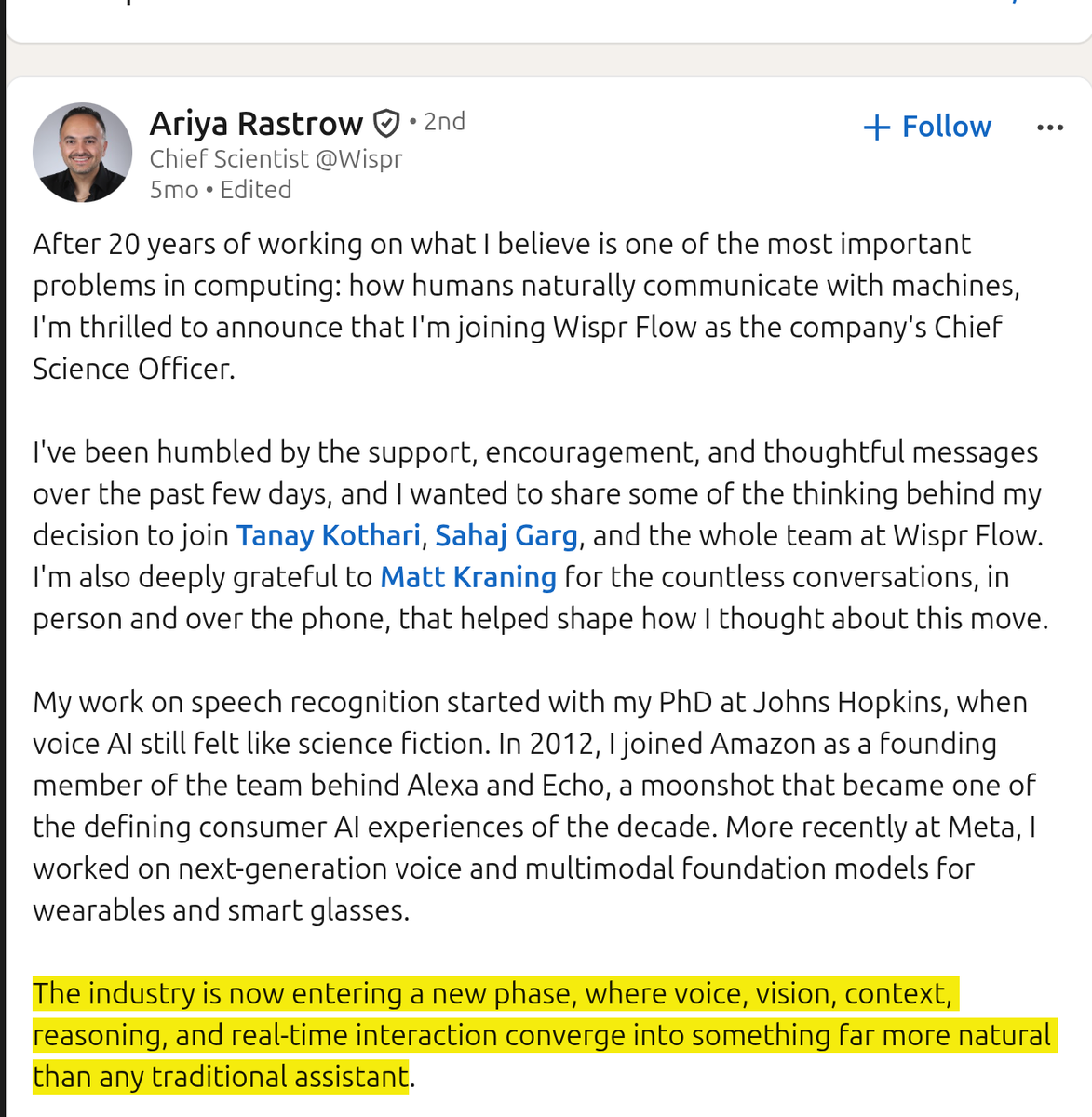
Rohan Paul, an AI commentator, summarized the move on November 15. Wispr Flow makes a voice dictation app. Rastrow, who did his PhD at Johns Hopkins and was a founding member of Amazon's Alexa team, announced on LinkedIn that he had joined as chief science officer.
Deep dive
According to Rohan Paul's post, Wispr Flow recently hired Ariya Rastrow as chief science officer and moved from rented speech engines to models it trains itself. Rastrow's LinkedIn announcement, shown in the post, says he began working on speech recognition during his PhD at Johns Hopkins, joined Amazon in 2012 as a founding member of the team behind Alexa and Echo, and more recently worked at Meta on voice and multimodal models for wearables and smart glasses.
Canto 1, the lab's first model, was built to cut how often people edit dictated text. Wispr trained it on noisy real world dictations and tunes it to each user's vocabulary and names. Paul's post says that on about 10 hours of real Flow dictations from more than 2,300 speakers, Canto 1 posted a 3.4 percent word error rate, lower than every competing model Wispr tested. A chart in the post shows Wispr Flow dictations needing a fix 20.6 percent of the time, against 24.2 percent for Gemini and 65.4 percent for Apple Dictation, on a Voice Arena dictation benchmark.
The training follows the large language model playbook: pretraining, supervised fine tuning and reinforcement learning with GRPO. The reinforcement learning stage uses corrections from users who opted in to share data. Wispr says slow dictations, those taking more than a second to appear, are down 54 percent since launch. These are company figures that have not been independently replicated.
What to expect next
Watch whether Wispr publishes more detail on Canto 1, opens it to other developers or extends it to more languages. Independent dictation benchmarks will show whether the gains hold outside Wispr's own data. Apple, Google and OpenAI all ship built in dictation, so the test is whether a focused startup can keep a measurable accuracy lead as those assistants improve.