Fortune: OpenAI Disbands Its Stand Alone Robotics Team, Betting General Models Like GPT 6 Astra Can Run Robots

Fortune is reporting that OpenAI is so convinced that LLMs will become brains for robots that it has disbanded its robotics team.
Context
If general models can control robots directly, the special robot brains that many startups have raised billions to build may matter less, and OpenAI is reorganizing around that bet.
OpenAI had a robotics team in its early years, wound it down in 2020, and rebuilt one in 2024. On November 13, Fortune reported in an exclusive that OpenAI has disbanded that stand alone team, and the company confirmed the reorganization. The lead post here is from prinz, an AI commentator, sharing an excerpt; OpenAI itself had not posted about it on X in the posts scanned.
Deep dive
According to Fortune, OpenAI moved its robotics research team into its main research organization, reporting to Chief Research Officer Mark Chen, while the applied robotics and hardware teams moved to the Applied organization under President Greg Brockman. A company spokesperson told Fortune that robotics remains a core part of OpenAI's long term vision and described the change as a sign of commitment, not a retreat.
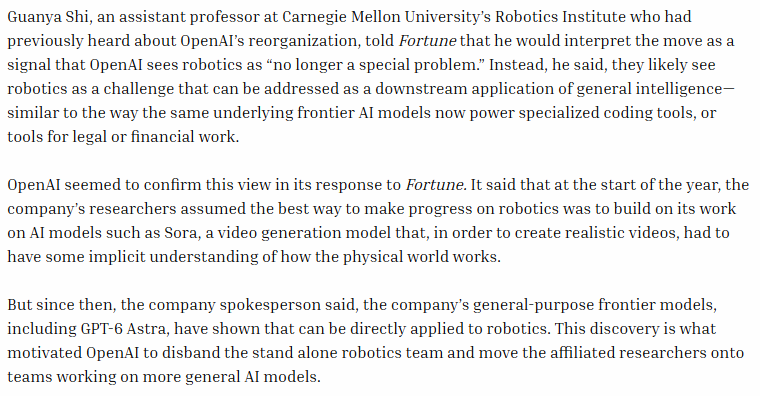
OpenAI told Fortune that at the start of the year its researchers believed the best path to robotics ran through models like Sora, but that its general frontier models, including GPT 6 Astra, have since shown they can be applied directly to robotics. Fortune cites an Nvidia study in which an Astra powered agent reached a 74.8% success rate on a simulated manipulation benchmark, compared with 51.0% for the best specialized robot models on that leaderboard.
Fortune reports that OpenAI had already registered booth 208 at CoRL, a top academic robotics conference in Austin this week, and that the booth sat empty when its reporter visited. The outlet later updated the story to clarify that former team members were present. It also notes that Sam Altman has targeted a first public demonstration of an OpenAI humanoid robot in 2027, and that the company is under pressure to cut costs, with reported operating losses of $10.9 billion in the most recent quarter.
Carnegie Mellon professor Guanya Shi told Fortune the move signals that OpenAI sees robotics as no longer a special problem. MIT professor Russ Tedrake said robotics companies still hold an edge in real world deployment data.
What to expect next
Watch whether OpenAI still shows its own humanoid robot in 2027, as Sam Altman has targeted, and how robotics now fits under Mark Chen and Greg Brockman. Results from general models running real robots, not only simulations, will test the bet. Robotics startups that raised money on the idea that robots need their own brains may face harder questions from investors.