Sundar Pichai: Gemini 4 Carbon Helped Formally Verify the Signal Protocol

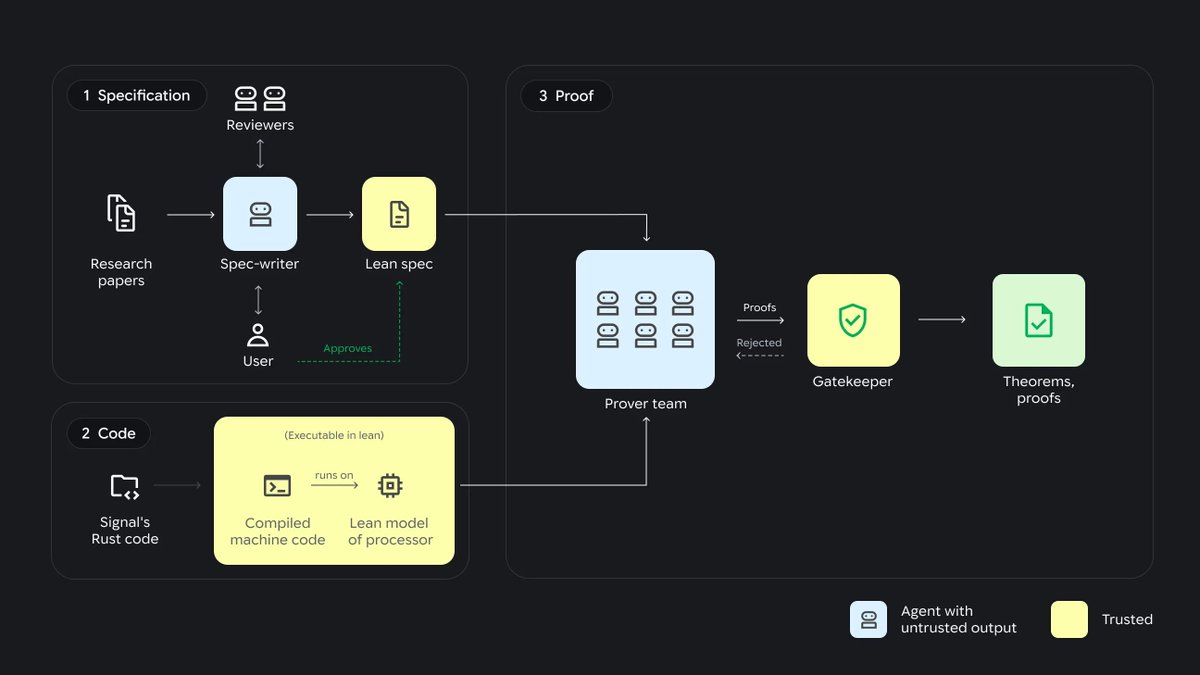
Our teams put Gemini 4 Carbon to work on a major security challenge: mathematically proving the code underlying the Signal protocol. Using AlphaProof Code, @GoogleDeepMind researchers guided agents to verify the protocol down to compiled device code, closing the gap where real bugs hide. The result: - Gemini 4 Carbon generated over 6M lines of machine-checked Lean proofs - years of expert manual verification compressed to just weeks ~1% of the codebase required human review (Lean automatically checked the rest) This is helping unlock scalable formal verification for building secure software, laying the groundwork to fundamentally shift the advantage to defenders. We’re open sourcing the results for the security community.
Context
A formal proof of a widely used messaging protocol, down to compiled device code, would raise the bar for what AI can do in software security.
Sundar Pichai, Google's CEO, posted that Google DeepMind researchers used Gemini 4 Carbon with AlphaProof Code to formally verify the Signal protocol down to compiled device code. He said Carbon generated over 6 million lines of machine checked Lean proofs, that years of expert manual verification were compressed to weeks, and that about 1% of the codebase required human review. Google opened Gemini 4 Carbon earlier today, a launch also covered in this deck.
Deep dive
Sundar Pichai posted that Google teams put Gemini 4 Carbon to work on mathematically proving the code underlying the Signal protocol. He wrote that, using AlphaProof Code, Google DeepMind researchers guided agents to verify the protocol down to compiled device code. According to Pichai, Carbon generated over 6 million lines of machine checked Lean proofs, years of expert manual verification were compressed to just weeks, and about 1% of the codebase required human review because Lean automatically checked the rest. He said Google is open sourcing the results for the security community.
Google DeepMind's own blog, published the same day, describes AlphaProof Code as an agent framework for formal verification that combines human expertise with AI agents. The blog says researchers first worked with models to translate Signal's security goals into formal specifications, with human experts reviewing every one, and that agents powered by Gemini Carbon then wrote the proofs. DeepMind said the process took four weeks, a task it said historically takes expert teams years, and that the work proves Signal's core cryptographic code delivers the security protections the experts specified. The blog also says the team reintroduced two real, previously fixed bugs into an isolated version of Signal's code, and that in both cases the system produced a machine checked proof that the buggy version was insecure.
DeepMind claimed this is the first time AI has been used to formally verify a widely deployed cryptographic protocol at this depth, and the first time the implementation of a widely deployed protocol like this has been formally verified by any method. Ehren Kret, Signal's chief technology officer, is quoted on the blog saying the approach enables a significant expansion of formal verification and gives Signal greater confidence in its privacy guarantees. Those broader firsts and the four week figure come from DeepMind's blog, while the 6 million line and 1% figures were also stated by Pichai.
What to expect next
The open sourced proofs and DeepMind's technical paper will be the first place outside Google to test these claims. Watch for independent researchers to inspect the Lean development, the trusted specification, and what was left out of scope. If the method holds up, the next question is whether the same pipeline can be applied to other critical software, which DeepMind said it wants to do. How much human review is still required outside this Signal result will decide how practical the approach is.