SpaceX Says Grok Now Detects Debris in Rocket Parts Better Than Human Inspectors

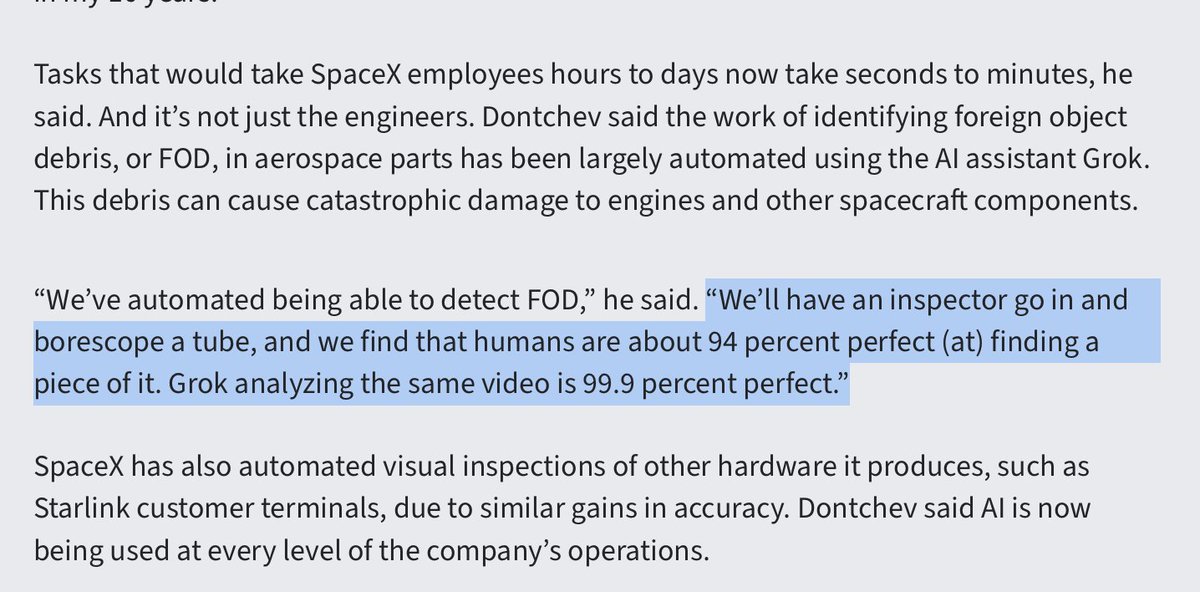
SpaceX VP of Launch @TurkeyBeaver says Grok is now helping them identify foreign object debris in aerospace parts, and that Grok (99.9%) is better at it than humans (94%). "We’ve automated being able to detect FOD. We’ll have an inspector go in and borescope a tube, and we find that humans are about 94% perfect (at) finding a piece of it. Grok analyzing the same video is 99.9% perfect." Full article:
Context
It is a concrete claim of an AI model beating human inspectors on a safety critical industrial task at a major aerospace company.
Foreign object debris, or FOD, is stray material inside aerospace parts that can badly damage engines and spacecraft components. Sawyer Merritt shared remarks from SpaceX's VP of Launch reported by Ars Technica, and Elon Musk quoted the post with the single word Grok.
Deep dive
Sawyer Merritt posted that SpaceX's VP of Launch says Grok is now helping the company identify foreign object debris in aerospace parts. According to the quote he shared, an inspector borescopes a tube and humans are about 94% accurate at finding a piece of debris, while Grok analyzing the same video is 99.9% accurate.
The article excerpt attached to the post says the work of identifying FOD has been largely automated using Grok, that SpaceX has also automated visual inspection of other hardware such as Starlink customer terminals because of similar accuracy gains, and that AI is now used at every level of the company's operations, as described by the official.
The accuracy figures come from a SpaceX official quoted in press coverage, not from a published test. SpaceX and xAI are both led by Elon Musk, who amplified the post with a quote post reading Grok that drew over 750,000 views by the time of this scan.
What to expect next
Watch whether SpaceX or xAI publish details on how the inspection system works, how its accuracy was measured, and whether the same approach is offered to other manufacturers. Claims of a model beating human inspectors on safety work are likely to draw questions about test conditions, sample sizes and failure cases, and regulators or customers may ask for independent verification.