Meta Launches Muse Ember, Its Smallest Most Efficient Model

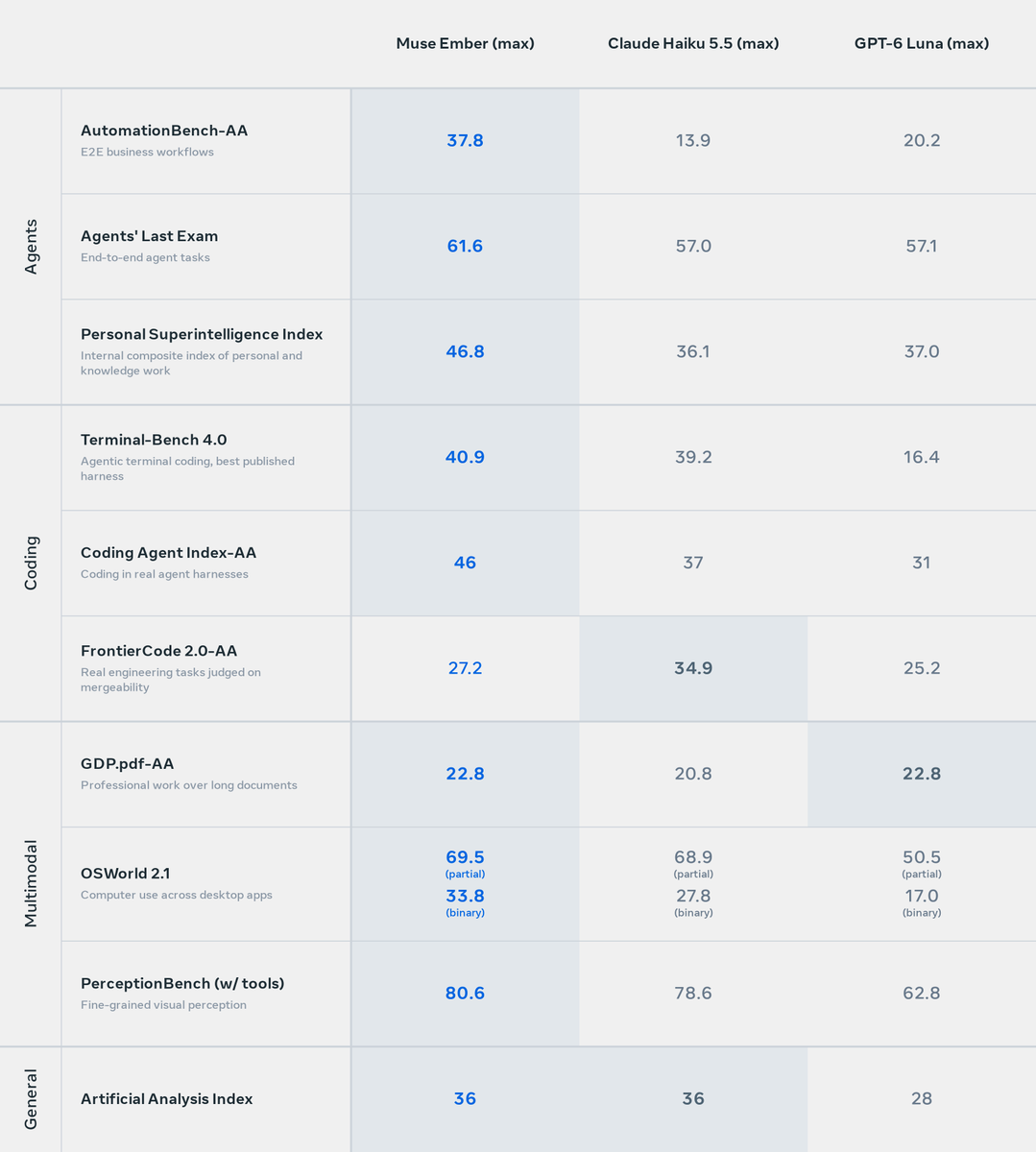
Today we're introducing Muse Ember, our smallest and most efficient model, built for complex reasoning execution and everyday agent work. Muse Ember can carry workflows across apps, call tools in sequence, run tests and make targeted code fixes. With a 1M-token context window and native understanding of text, images, audio and video, it can also work across large document sets and varied inputs.

Context
A cheap, small Meta model aimed at agent workflows changes the cost curve for high volume tool use.
AI at Meta introduced Muse Ember as its smallest and most efficient model for everyday agent work, with a 1M token context window and native text, image, audio, and video understanding. Alexandr Wang said Ember offers nearly Muse Spark 1.3 max intelligence at a far lower price point per Artificial Analysis.
Deep dive
Meta's AI at Meta account launched Muse Ember as its smallest and most efficient model, aimed at complex reasoning execution and everyday agent work. The post says Ember can carry workflows across apps, call tools in sequence, run tests, and make targeted code fixes, with a 1M token context window and native understanding of text, images, audio, and video.
A follow up Meta post said Ember is available on the Meta Model API at $0.10 per million input tokens and $0.50 per million output tokens. Alexandr Wang separately said Ember offers nearly Muse Spark 1.3 max intelligence at a 17x cheaper price point per Artificial Analysis, and called it the first Meta release trained using Muse Wonder Full.
Later posts said Ember, Muse Wonder, and Muse Spark 1.3 were also coming to Google Cloud. This scan treats the AI at Meta launch post as the official lead and does not restate third party benchmark numbers beyond what Meta and Wang cited.
What to expect next
Watch API uptake, Google Cloud availability, and how Ember compares with Haiku class models on cost per task.