Stanford and Google DeepMind Paper Uses AlphaEvolve to Make Easy Tool Use Benchmarks Hard Again

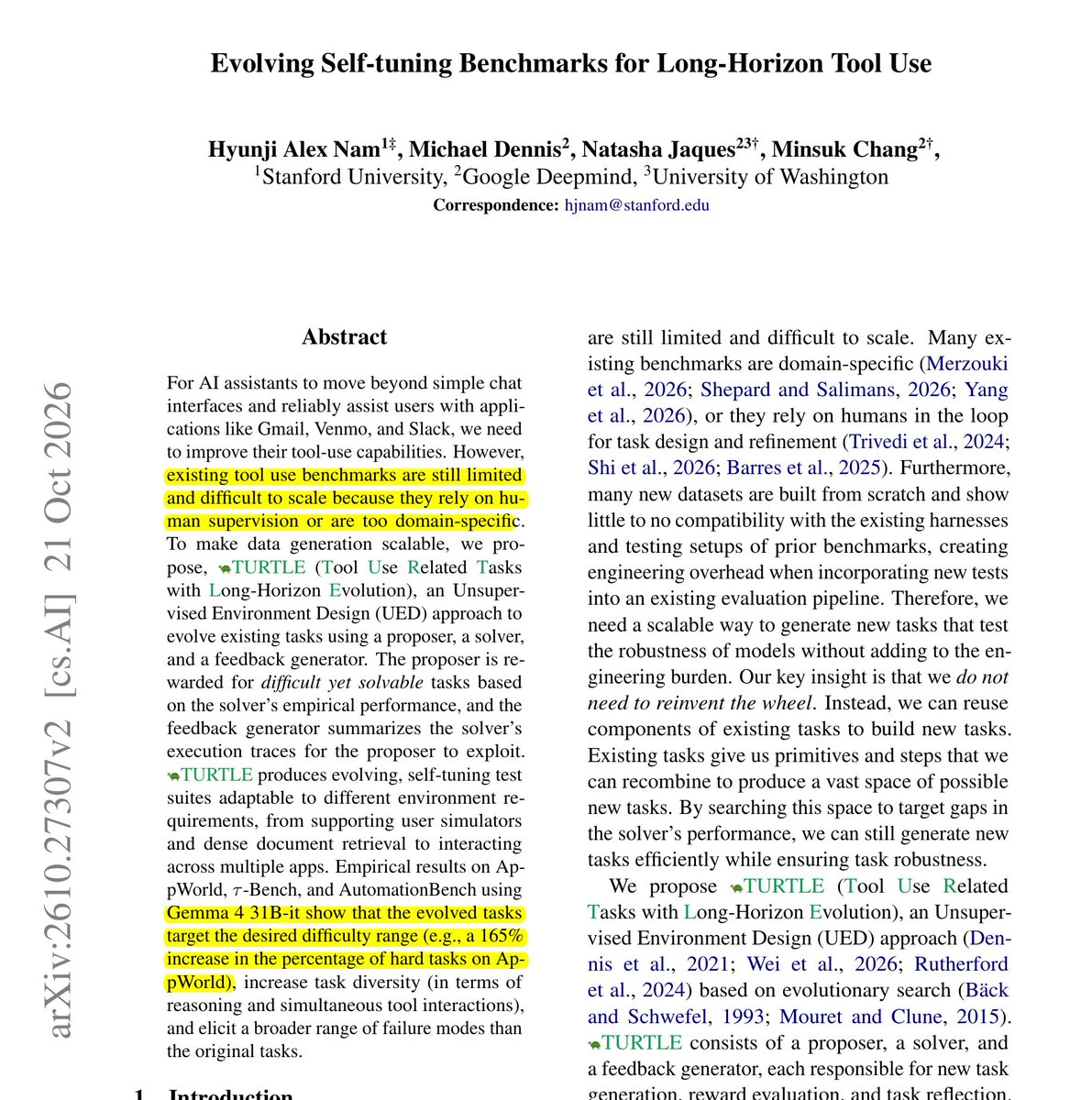
New Stanford and Google DeepMind paper shows that you can turn too-easy tool-use benchmarks into hard, still-solvable tests by evolving existing tasks against the model. Tool-use benchmarks like AppWorld are static, so models soon solve most tasks, and building new ones takes human work. TURTLE uses AlphaEvolve to mutate existing tasks, adding filters, extra steps and hidden lookups, then runs the solver model 10 times on each. Tasks score highest when the solver succeeds about 50% of the time, and each must be solved at least once. 69% of original AppWorld tasks were always solved by Gemma 4 31B-it, while nearly all 735 evolved tasks sat at 40% to 60% completion. An LLM judge rated 52.5% of evolved tasks hard, versus 19.8% of the originals. If your model aces a benchmark, evolve its tasks toward a 50% success rate instead of writing a new benchmark from scratch.
Context
Instead of writing new benchmarks by hand, labs could evolve old ones to keep pace with stronger models.
Rohan Paul summarizes a Stanford and Google DeepMind paper on TURTLE, which uses AlphaEvolve to mutate existing tool use tasks until the solver model succeeds about half the time. On AppWorld, 69% of original tasks were always solved by Gemma 4 31B, while nearly all 735 evolved tasks landed at 40% to 60% completion. The paper itself was not opened.