David Gross Led Physics Committee Says OpenAI's Claimed Yang Mills Existence Proof Appears to Be an Important Step and Will Be Checked in Lean Before Release

Statement of Yang-Mills Working Group, a scientific collaboration to interpret AI result related to the existence of quantum chromodynamics & completions of the Standard Model, including a subproblem proving the existence of the Quantum Yang-Mills theory.

Context
A committee of leading theoretical physicists, chaired by Nobel laureate David Gross, now says publicly that an AI produced proof touching a Clay Millennium Prize problem appears to be an important step, and it has set out how the community will verify it before anyone sees the full proof.
On October 26, OpenAI said its internal models had produced a rigorous existence proof for quantum chromodynamics, including the existence of quantum Yang Mills theory, and that a group led by David Gross would shepherd the work. The Kavli Institute for Theoretical Physics at UC Santa Barbara has now published that group's first statement. Earlier on October 27, Andrew Curran reported that the Advisory Group on Mathematics and Artificial Intelligence was calling for the AI output to be released immediately.
Deep dive
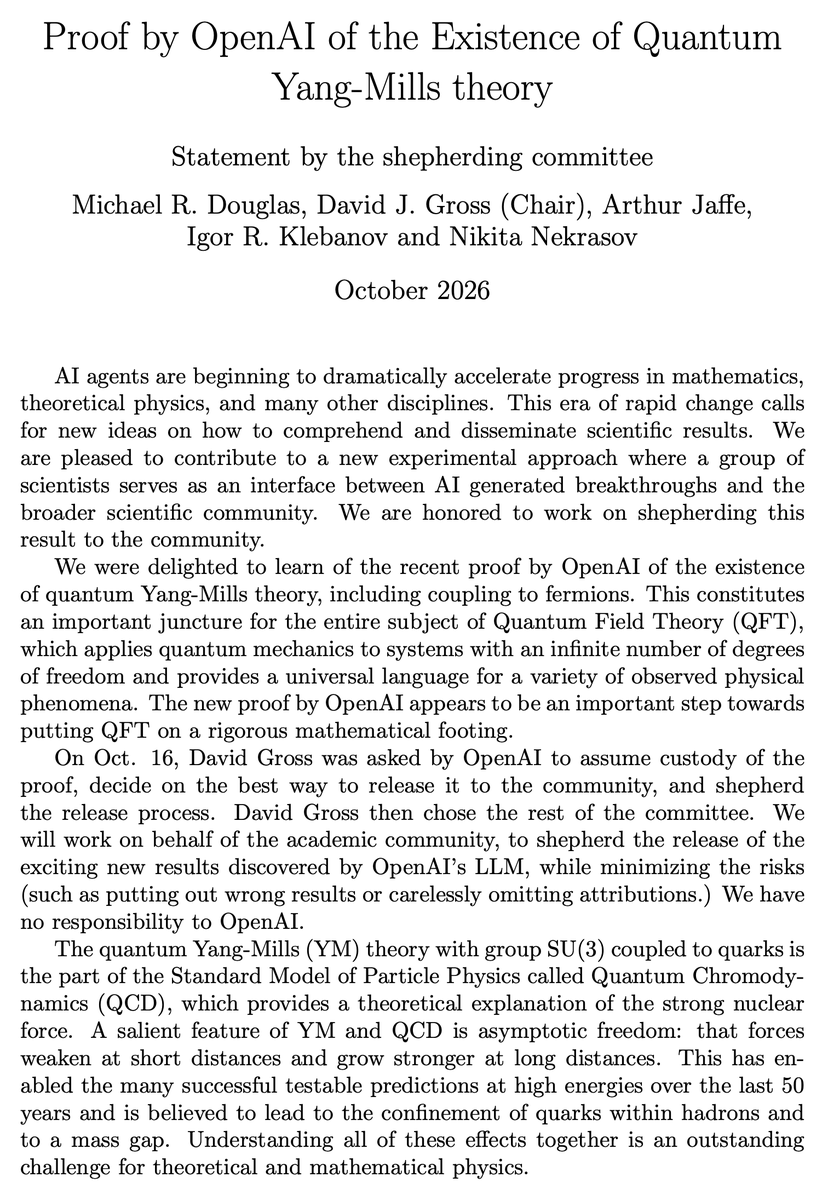
The Kavli Institute for Theoretical Physics posted the first statement from the Yang Mills Working Group, the committee OpenAI asked to take custody of its claimed proof. The committee is Michael R. Douglas, David J. Gross as chair, Arthur Jaffe, Igor R. Klebanov and Nikita Nekrasov.
According to the statement, OpenAI asked Gross on October 16 to take custody of the proof, decide how to release it and shepherd that release, and Gross then picked the other members. The committee writes that it has no responsibility to OpenAI and works on behalf of the academic community, aiming to limit risks such as publishing wrong results or leaving out attributions.
The committee describes the result as a proof of the existence of quantum Yang Mills theory, including coupling to fermions, and says it appears to be an important step towards putting quantum field theory on a rigorous mathematical footing. It credits decades of earlier work, including Kenneth Wilson's 1974 lattice approach and Tadeusz Balaban's renormalization group papers from the 1980s, which it says helped OpenAI reach the continuum limit. It also states plainly that confinement and the mass gap remain very important open challenges, which means this is not a claim to have solved the full Millennium Prize problem.
The release plan has several stages. OpenAI is providing a Lean formalization. The committee will first check that the definitions and problem statement match the standard ones in physics and mathematics, and then release the Lean proof. After further study with outside experts, it plans to publish its assessment together with the full 1147 page LLM proofs. The committee calls the process an experiment in how science can absorb fast AI discoveries and says it will proceed very carefully.
What to expect next
The next milestone is the release of the Lean proof, which the committee says will follow only after it confirms that the formal definitions match standard physics and mathematics. Watch for pressure from groups such as the Advisory Group on Mathematics and Artificial Intelligence, which wants the AI output released immediately, and for how long the committee takes to review 1147 pages. Its custody model could become a template for other AI claims in physics, while the mass gap question stays open.