Google DeepMind and University Study Finds AI Agents Solved 49 of 50 Unpublished Research Level Theoretical Physics Problems for Under 3 Dollars Each

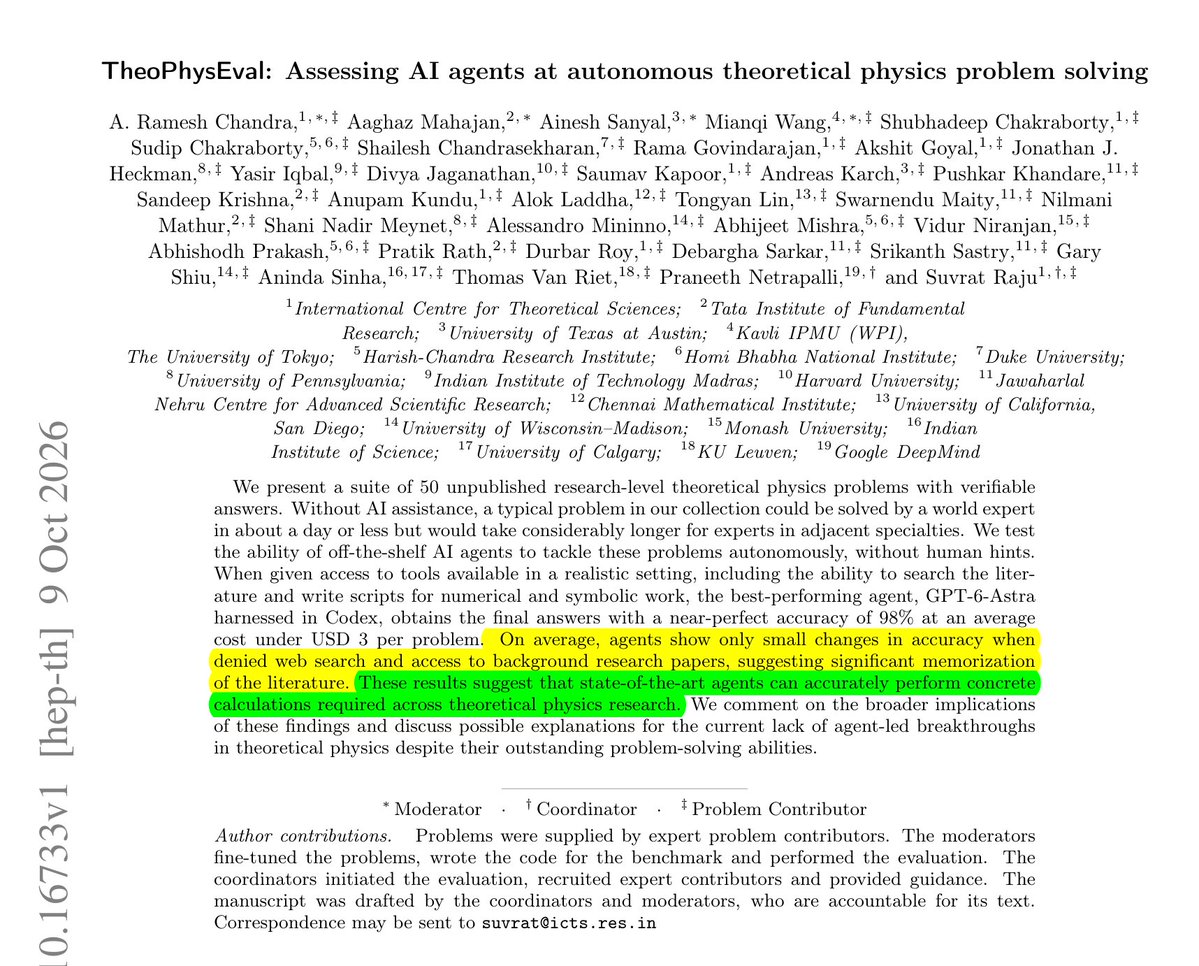
New paper from Google Deep Mind, and many top Universities finds the best AI agent tested solved 49 of 50 unpublished research-level theoretical physics problems, each roughly a day's work for a world expert. at under $3 each. Benchmarks for AI in physics often use textbook or contest problems, or block the tools real researchers use. So it was unclear how agents handle the calculations that fill daily research. Experts contributed 50 unpublished problems from their own research, each about a day's work for a specialist. Agents worked alone, with and without web search, and were graded only on final numerical answers. GPT-6-Astra in Codex solved 49 of 50 with web search, and both it and Opus 5.5 in Claude Code solved 46 of 50 without it. Accuracy barely changed without search, which suggests the models have memorized much of the physics literature.
Context
Solving 49 out of 50 unpublished specialist calculations that each take a human physicist roughly a day shows frontier coding agents can now handle routine graduate and postdoctoral analytical derivations at low cost.
Most physics benchmarks for large language models rely on Olympiad competitions or published textbook exercises, and often restrict agents from writing and executing verification scripts. To measure real scientific utility, researchers from Google DeepMind and partner universities collected 50 unpublished calculation problems directly from working theoretical physicists.
Deep dive
A new evaluation paper by researchers at Google DeepMind and partner universities reports that the top performing AI agent solved 49 out of 50 unpublished research level theoretical physics problems at an average compute cost under 3 dollars per problem, as summarized on X by Rohan Paul. Each problem was contributed from active, unpublished research by a domain specialist and represented roughly one full day of analytical calculation for an expert physicist.
Unlike earlier benchmarks that test models in a single chat turn without external tools, this study evaluated full coding agents running in realistic environments, both with and without live web search, and graded them strictly on their final numerical answers. According to the paper's results chart, OpenAI's GPT 6 Astra running inside the Codex harness solved 49 of the 50 problems when allowed to use web search. When web search was disabled, both GPT 6 Astra in Codex and Anthropic's Claude Opus 5.5 running inside Claude Code solved 46 of the 50 problems.
The authors note that disabling web search barely reduced accuracy across the 50 unpublished tasks, indicating that frontier models have already internalized much of the foundational theoretical physics literature and can reconstruct complex multi step derivations by combining internal knowledge with symbolic and numerical Python execution inside an agent loop.
What to expect next
Theoretical physics groups will increasingly integrate coding harnesses like Codex and Claude Code to check multi page analytical derivations, perturbation expansions, and numerical integrals before publication. Benchmark authors will next need to test open ended problem formulation and multi week research tasks where the target equation is not already specified. If coding harnesses continue solving day long specialist calculations for a few dollars in API credits, university departments and national laboratories will shift graduate training toward problem selection, physical interpretation, and verifying AI generated derivations.