Modders Unlock Capped FP16 and BF16 Tensor Core Throughput on Nvidia RTX 20, 30, and 40 Series GPUs via Linux Pre Driver Register Overrides

Modders have unlocked hidden AI compute performance on NVIDIA’s RTX 20, 30 and 40-series GPUs. The modifications remove software-level limits on certain Tensor Core operations, without changing the hardware or flashing a new VBIOS. - RTX 4090: 165.6 → 331.6 TFLOPS FP16 Tensor Core throughput -RTX 3090 Ti: 87.5 → 157.4 TFLOPS BF16 performance - RTX 2080 Ti: 59.9 → 111 TFLOPS FP16→FP32 performance - RTX 3090: 73.0 → 122.8 TFLOPS in a PyTorch GEMM test The gains are mainly relevant to AI and compute workloads, not gaming.
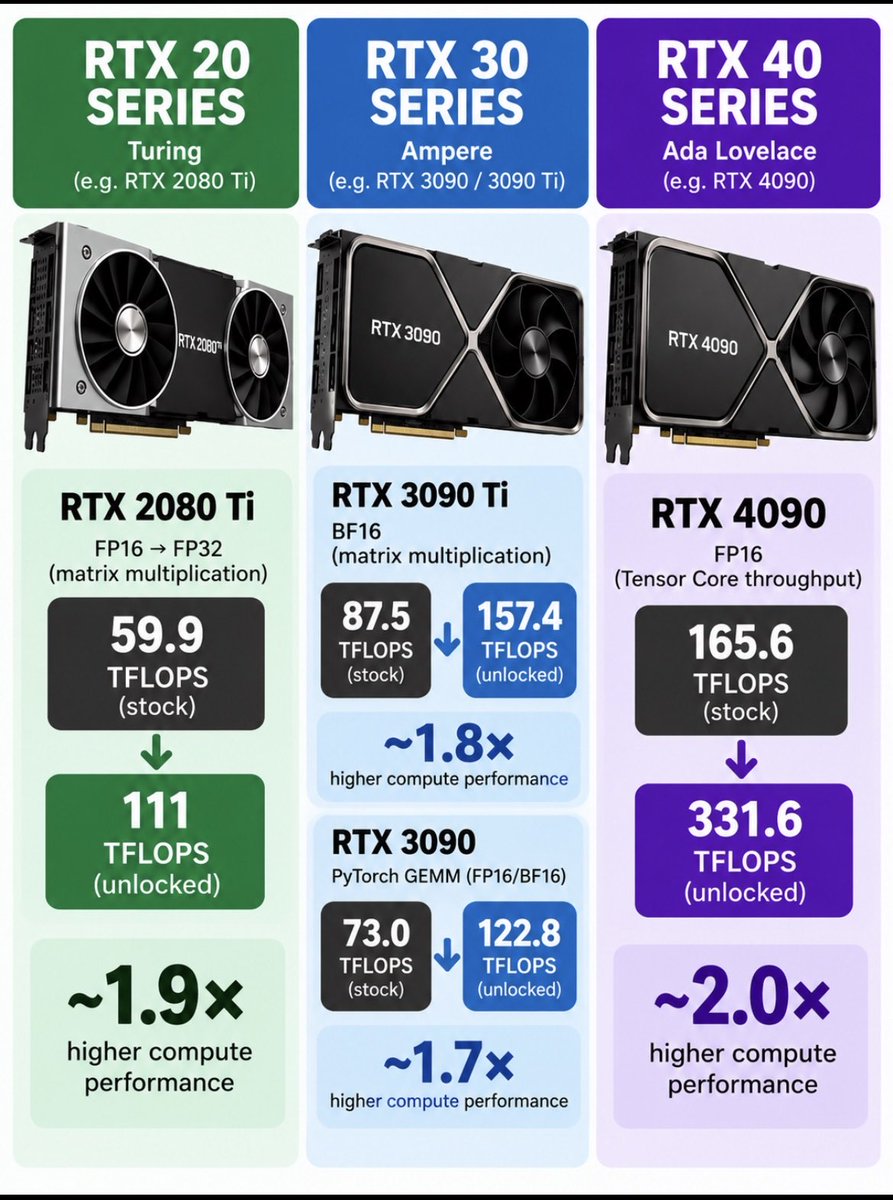
Context
Bypassing Nvidia's artificial rate limits on FP16 and BF16 Tensor Core operations with FP32 accumulation boosts local AI matrix math and prompt processing on existing consumer GeForce cards without hardware soldering or VBIOS flashing.
For years Nvidia has segmented its consumer GeForce graphics cards from higher priced workstation and data center GPUs by halving the instruction issue rate of FP16 and BF16 Tensor Core operations that accumulate into FP32 precision. While physical silicon on Turing, Ampere, and Ada Lovelace GPUs contains full rate tensor units, firmware and register locks cap their throughput on GeForce models.
Deep dive
Open source hardware modders have published Linux kernel modules that remove Nvidia's artificial throughput caps on FP16 and BF16 Tensor Core operations with FP32 accumulation across consumer GeForce RTX 20, 30, and 40 series GPUs, as reported by VideoCardz and summarized on X by Pirat_Nation. Rather than soldering hardware resistors or flashing a custom VBIOS, the tools run at Linux boot in the initramfs before the stock Nvidia driver loads, using an analysis of Nvidia's debug booter to override streaming multiprocessor speed select configuration registers. The register override survives PCIe Function Level Reset and standard CUDA initialization, and resets cleanly whenever the GPU is powered off.
The effort builds on developer Zagitta's GPU Unlock project for Ampere RTX 30 cards, TOTORONG's AD103 unlocker payload, and JustAResearcher's GPU Unlock Ada repository for Ada Lovelace GPUs. According to community benchmark figures reported by the modders, register level instruction throughput for FP16 with FP32 accumulation on an RTX 4090 doubles from 165.6 to 331.6 TFLOPS, with BF16 rising from 165.5 to 330.6 TFLOPS. On Ampere, modders report an RTX 3090 Ti rising from 87.5 to 157.4 TFLOPS in BF16 and an RTX 3090 rising from 73.0 to 122.8 TFLOPS in PyTorch GEMM, while developer KohakuBlueleaf demonstrated a Turing RTX 2080 Ti climbing from 59.9 to 111 TFLOPS.
Independent testing highlighted on DEV Community notes an important distinction between raw instruction issue rates and end to end workloads. While microbenchmarks show double the tensor instruction throughput on an RTX 4090, real cuBLAS GEMM matrix multiplications gain 12 to 34 percent in FP16 and 16 to 20 percent in BF16 depending on matrix shape. On an RTX 3090, LLM prompt processing improves by roughly 14 to 36 percent, whereas token generation remains largely unchanged because it is bound by memory bandwidth, and gaming frame rates are unaffected.
What to expect next
Local AI enthusiasts running 24GB RTX 3090 and RTX 4090 workstations will test the Linux kernel modules on real LLM prompt prefill, LoRA fine tuning, and image diffusion workloads to verify long term thermal and numerical stability under stock power limits. The hardware community will also watch whether Nvidia blocks the pre driver register override in upcoming Linux driver releases or whether modders extend the technique to RTX 50 series Blackwell cards.