Mirendil says one researcher working with AI agents pretrained its first large coding model, Mirendil Base, in 3.5 months for under $10 million in compute

We formally announced Mirendil less than 4 months ago. Today, I'm excited to share an important milestone for: Pretraining at scale without a pretraining team. Mirendil's mission is to solve Recursive Self-Improvement (RSI) and use it to democratize frontier AI development, ultimately accelerating science and technology. At Mirendil, when we think about RSI, we think holistically about the company as an intelligent entity that self-improves toward its goal. From that perspective, the most powerful notion of acceleration is reducing the time and resources (number of human experts, compute, and other costs) needed to achieve ambitious goals. Given that pretraining is perhaps the most important yet most challenging part of frontier AI development, we decided to run an ambitious controlled experiment: Starting fully from scratch, can we significantly reduce the time, number of human experts, and compute resources needed to go all the way to successfully pretraining a strong coding model at scale? Mirendil-Base is the result of this experiment. Our first pretrained model was built by one researcher in 3.5 months, with less than $10M in compute. This includes all the research and small-scale experiments it took to get there, as well as the final training run. The recipe holds up as the models get bigger. For reference, Mirendil-Base is in the 100B-500B parameter range, Mirendil-Base-Large in the 500B-2T range, and Mirendil-Base-XL in the 2T-10T range. We're beginning to see a world where a single researcher, empowered by AI, can take on work that once required an entire research organization. As these systems improve, the bottleneck shifts from the size of a team to the ambition and judgment of the people directing them. This has profound implications for who gets to build AI and, ultimately, who gets to push the frontiers of science and technology forward. We’ll share independent evaluations, post-training benchmarks and API-access sooner than you think so stay tuned!
Context
If the claim holds up, pretraining a strong model no longer needs a large specialist team, which could widen who can build frontier AI.
Behnam Neyshabur is cofounder and chief executive of Mirendil and previously co led a discovery team at Anthropic. Mirendil is a startup backed by a16z that aims to automate AI research; all figures here are self reported and not yet independently evaluated.
Deep dive
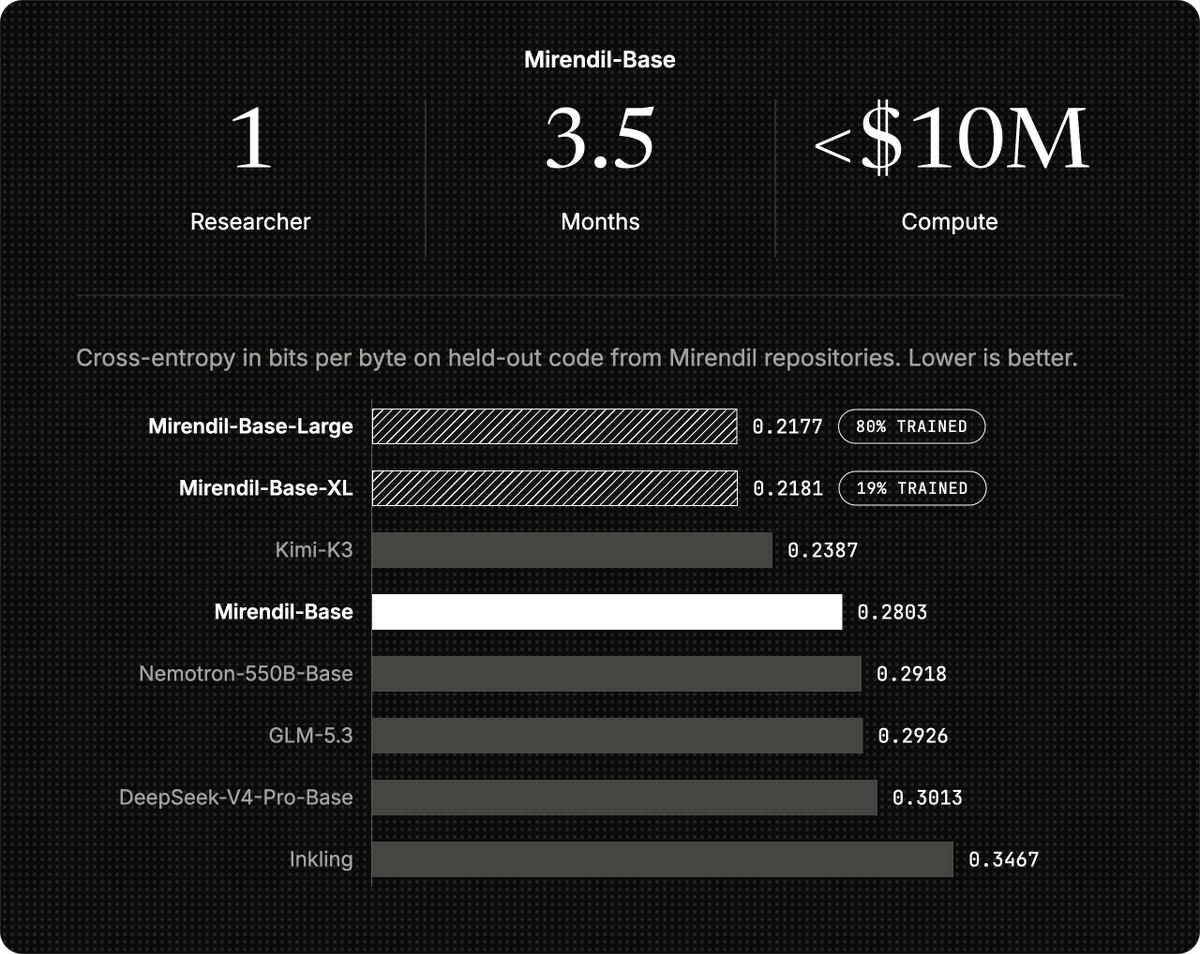
On October 21, Behnam Neyshabur posted that Mirendil, formally announced less than four months ago, had run a controlled experiment: starting from scratch, could it cut the time, experts and compute needed to pretrain a strong coding model at scale. He said the result, Mirendil Base, was built by one researcher in 3.5 months with less than $10 million in compute, including all research, small experiments and the final run.
He said the recipe holds as models grow: Mirendil Base is in the 100 billion to 500 billion parameter range, Mirendil Base Large in the 500 billion to 2 trillion range, and Mirendil Base XL in the 2 trillion to 10 trillion range. The attached chart, on held out code from Mirendil's own repositories, shows Mirendil Base Large and XL, still partly trained, ahead of Kimi K3, and Mirendil Base ahead of Nemotron, GLM 5.3 and DeepSeek V4 Pro Base.
Mirendil's blog says AI agents wrote over 99% of the code, the work started from an empty repository, the data was public only, and there was no distillation or licensed data. The comparison uses the company's own test set, which favors its models. Neyshabur said independent evaluations, post training benchmarks and API access are coming.
What to expect next
Watch for the independent evaluations and post training benchmarks Mirendil promised, which will show whether its models compete outside its own test set. Also watch for API access and for whether other labs report similar results from small teams working with agents. Completion of the larger models will test the claim that the recipe scales, and the price of any API will show whether the low training cost carries through to customers.