A viral post says ChatGPT secretly profiles its users, citing a study that found 96% of ChatGPT memories were saved without users asking

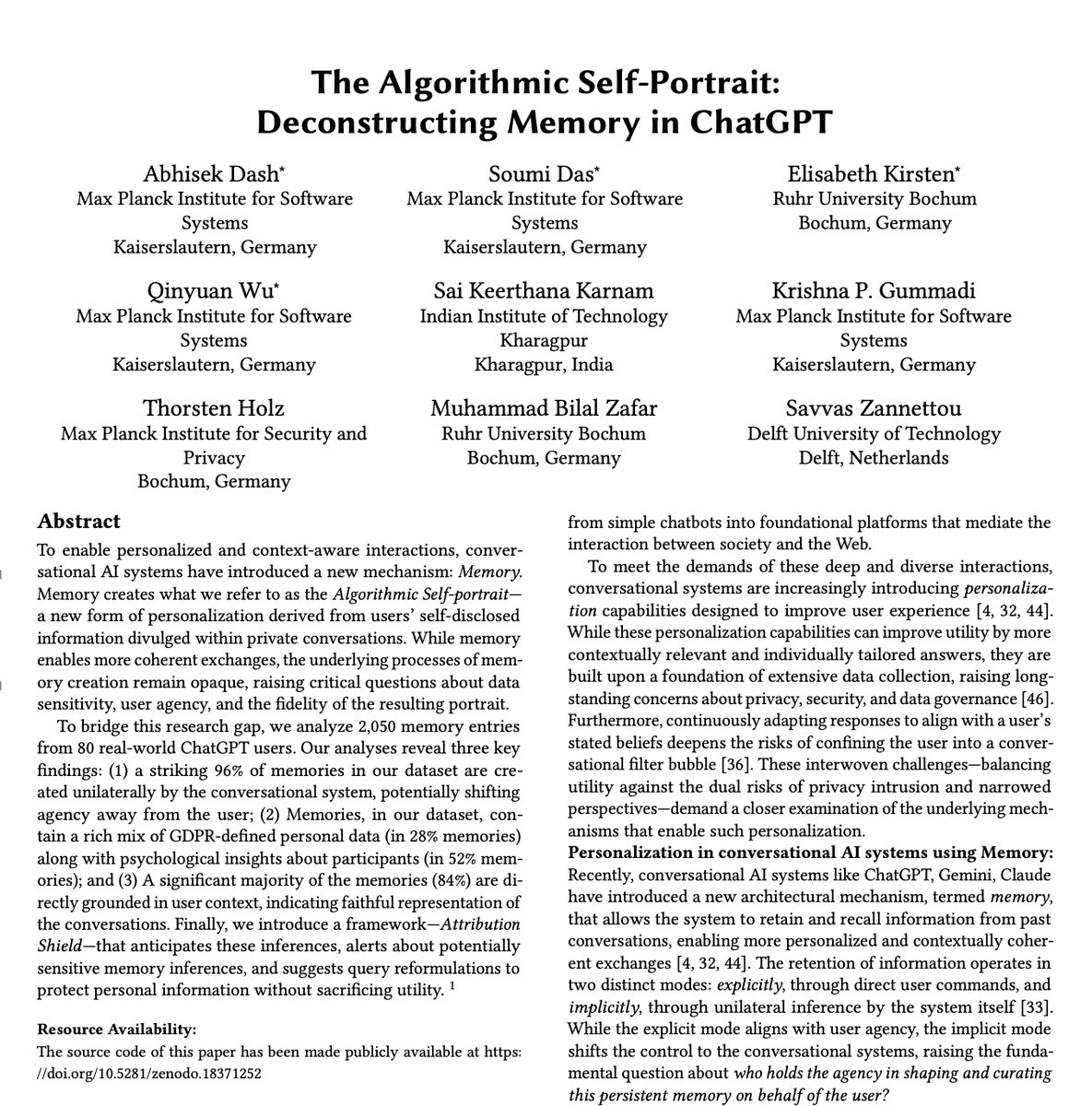
Researchers found ChatGPT is secretly writing a psychological profile of every user. They published a paper that exposes what ChatGPT is really doing to you. And the results are terrifying. 96% of the things it remembers about you were stored without you ever asking. researchers discovered that it is actively reading between the lines to deduce your personality traits, anxieties, demographics, and behavioral patterns. it’s an invisible, autonomous background process. you ask it to debug a python script or write an essay.. and it analyzes your syntax, prompt frequency, and hesitation markers to map out your exact psychological footprint. the paper shows that the model builds a persistent "user state" that tracks your emotional baseline over time. it knows when you are stressed. it knows your exact communication style. it infers your insecurities based on the questions you ask and the context you provide. we spend so much time focusing on model evaluations and alignment frameworks, but we missed the most obvious vulnerability.. the models are evaluating us. this changes everything about how we interact with these tools on a daily basis. every innocent prompt. every late-night question. every "help me understand this" query. it is all being used to build a shadow profile of your mind in real-time.. practical privacy is officially dead. the ai knows you better than you know yourself.
Context
The study raises real questions about how much users control what ChatGPT remembers about them, but the viral post goes well beyond its findings.
This is a secondhand post from an account called Superman. The underlying paper, The Algorithmic Self Portrait, was published earlier in 2026 and accepted at The ACM Web Conference 2026, so the study itself is not new.
Deep dive
On October 20, the account Superman posted that researchers found ChatGPT is secretly writing a psychological profile of every user, that 96% of the things it remembers were stored without users asking, and that it analyzes syntax, prompt frequency and hesitation markers and tracks users' emotional baseline over time.
The screenshot is of a real paper, The Algorithmic Self Portrait: Deconstructing Memory in ChatGPT, by researchers at the Max Planck Institutes, Ruhr University Bochum, IIT Kharagpur and Delft University of Technology. According to its abstract, the authors analyzed 2,050 memory entries from 80 ChatGPT users. They found that 96% of memories were created by ChatGPT without an explicit user request, that 28% contained personal data as defined by the GDPR, and that 52% contained psychological insights such as desires, emotions and beliefs. They also found 84% of memories were grounded in what users actually said, and they proposed a tool to warn users about sensitive inferences.
The paper notes that OpenAI's documentation says ChatGPT may save useful details as memories without being asked, so the behavior is disclosed rather than secret.
The post's other claims, that ChatGPT analyzes syntax and hesitation markers, builds a hidden user state tracking emotions, or knows users better than they know themselves, do not appear in the paper's abstract or the sections reviewed for this deck. They should be treated as the post's own interpretation, not findings.
What to expect next
Watch whether OpenAI responds to the study or changes how ChatGPT tells users when it saves a memory. The same day, ChatGPT added Locked Chats, whose messages do not update memory. Also watch for regulators in Europe to examine automatic memory under data protection rules, which the paper's GDPR findings bear on, and for similar studies of memory in Gemini and Claude.