The AI buildout is on track to be the biggest economic bet in US history as a share of GDP, according to The Wall Street Journal and a Brookings study

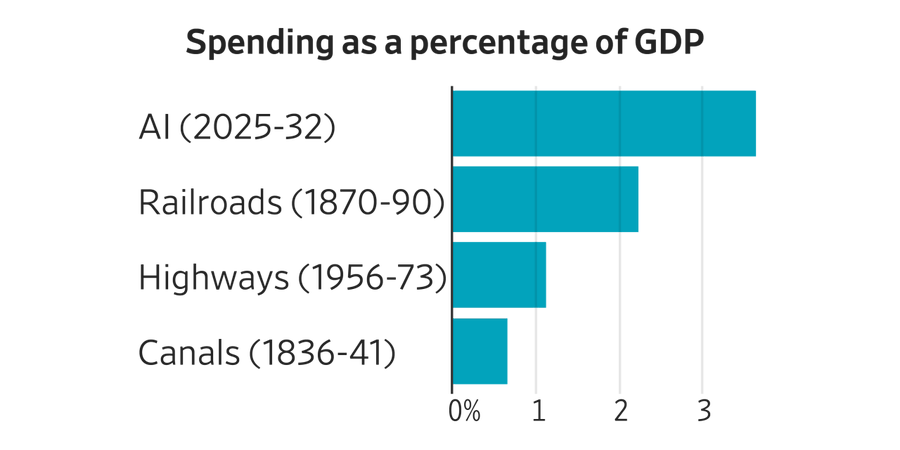
The AI buildout is now the biggest investment boom in U.S. history, per WSJ:
Context
Spending at this scale is already lifting jobs, prices and interest rates, so how it pays off matters well beyond the tech industry.
This is old news resurfaced: the WSJ story on a Brookings Institution study ran around September 24, and the chart in the post is from it. The study is by Columbia Business School professor Stijn Van Nieuwerburgh. It relates to story 31 in the October 12 deck, on investment in information processing equipment and software reaching a record 5.05% of GDP.
Deep dive
On October 13, unusual_whales posted that the AI buildout is now the biggest investment boom in U.S. history, per WSJ, with a chart comparing spending as a share of GDP.
According to Quartz, summarizing the WSJ, the Brookings study puts total spending on data centers and related AI infrastructure at $10.3 trillion from 2025 to 2032, about 3.6% of GDP each year. That tops the 2.2% of GDP absorbed by the railroad boom of the late 1800s, the previous record, and is more than three times the share for the interstate highway network or the telecom expansion of the 1990s.
The WSJ cited FactSet data showing that capital spending at Alphabet, Amazon, Meta, Microsoft and Oracle is on pace to total $4.2 trillion over four years through 2029, increasingly financed with debt, often through off balance sheet vehicles. Van Nieuwerburgh compared the opacity of those vehicles to the subprime mortgage crisis, and said the AI industry would need about $3.7 trillion in annual revenue by 2032 to hit its return targets.
Quartz reported that LinkedIn data credit AI with more than 750,000 US jobs from 2023 to 2026, and that import prices for computers, peripherals and semiconductors were 20% higher in August than a year earlier. Van Nieuwerburgh wrote that strong demand could support the buildout, but that uncertain demand and high leverage create meaningful downside risk.
What to expect next
Watch whether hyperscaler capital spending keeps rising in upcoming earnings, and how much of it is funded with debt and off balance sheet vehicles that the Brookings study flagged.
Also watch AI revenue growth at OpenAI, Anthropic and the cloud providers against the roughly $3.7 trillion the study says is needed by 2032, and whether regulators look more closely at the financing behind data centers.