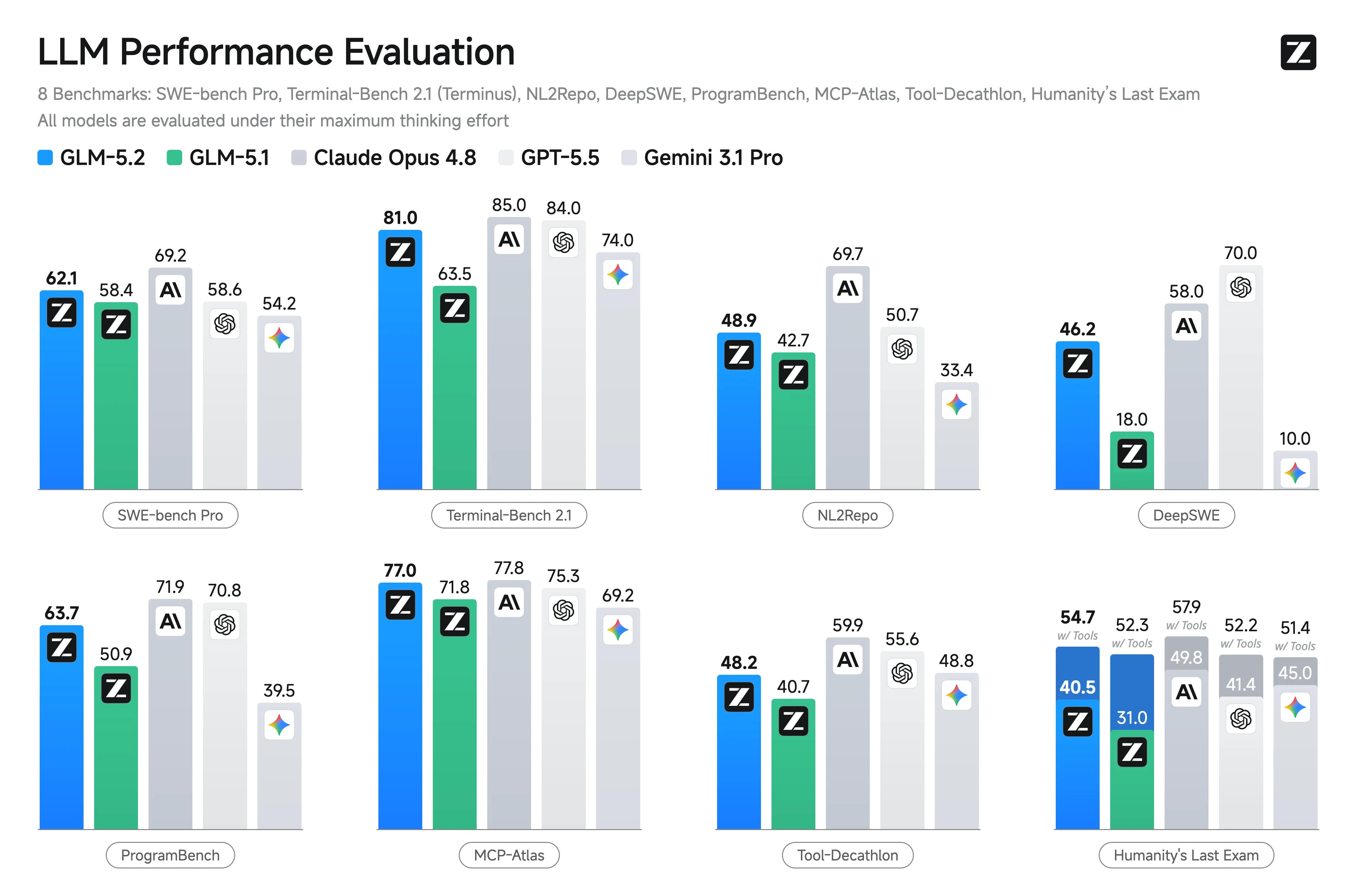
GLM-5.2 is worth paying attention to because it shows a bigger shift:
Open-source models are getting close enough to frontier AI that they can become a real option for serious work.
That does not mean everyone should instantly switch from ChatGPT, Claude, or Gemini.
It means users and businesses should stop thinking of open models as only "cheap alternatives." Some are becoming serious tools for coding, agents, and long-horizon engineering work.
What Changed
Z.ai, formerly known as Zhipu AI, released GLM-5.2, a new large language model focused on long-horizon autonomous coding and engineering tasks.
Reports say GLM-5.2 performs strongly across benchmarks such as SWE-bench Pro, Terminal-Bench, MCP-Atlas, Tool-Decathlon, Humanity's Last Exam, and other coding or agentic evaluations. Some reporting frames it as beating or matching major closed models on key benchmarks, including comparisons against GPT-5.5 and Gemini.
Benchmarks should always be treated carefully. They are useful signals, not final truth.
But the direction matters:
Open models are no longer only for hobbyists. They are moving into the territory of real developer and business workflows.
Why It Matters
Closed frontier models are powerful, but they come with tradeoffs:
- pricing can change
- access can be restricted
- model behavior can change
- data rules may not fit every company
- you depend on the provider's roadmap
- some use cases may be blocked by policy
Open models offer a different promise:
- more control
- local or private deployment
- customization
- lower long-term cost
- less dependence on one lab
- easier fallback strategy
The point is not that open models are always better.
The point is that they give users and builders more options.
Who Should Care
Developers should care because GLM-5.2 appears aimed at coding agents, long tasks, and software engineering workflows.
Startups should care because open models can reduce dependence on expensive APIs once a workflow becomes repetitive.
Businesses should care because the Fable/Mythos restriction story showed that access to frontier models can become a policy issue, not just a product issue.
Students and normal users should care less about the benchmark battle and more about the trend: strong AI will increasingly be available outside the biggest closed platforms.
How To Use This Practically
If you are a normal user, do not rush to replace your daily AI tool.
If you are a developer or business owner, start testing open models on bounded tasks:
- code review assistance
- documentation drafts
- test generation
- structured extraction
- internal Q&A
- support-ticket classification
- repetitive analysis
- low-risk agent workflows
Do not start with your hardest task. Start with work where you can compare output quality against your current model.
Use this evaluation prompt:
Compare this model against my current AI tool on this workflow:
[describe workflow]

Measure:
1. accuracy
2. speed
3. cost
4. formatting quality
5. hallucination risk
6. human review time
7. whether the result is good enough for production
The key phrase is good enough for production.
You do not need the best model for every task. You need a model that reliably solves the task at the right cost and risk.
What To Avoid
Do not blindly trust benchmark screenshots.
Before using GLM-5.2 or any open model seriously, check:
- license terms
- hosting requirements
- context window
- tool-use support
- safety behavior
- inference cost
- whether your team can maintain it
- how it performs on your own tasks
Also avoid assuming "open" means "easy." Running a powerful model well still requires infrastructure, evaluation, and monitoring.
Bottom Line
GLM-5.2 matters because it shows open-source AI is moving closer to frontier capability in the areas that matter most for work: coding, agents, and long-horizon reasoning.
The practical takeaway:
Use closed frontier models when you need the strongest general reasoning. Test open models when control, cost, privacy, or reliability matter.
The future is not one model winning everything.
The future is choosing the right model for the job.
Sources used: Economic Times on GLM-5.2, Z.ai company background, and Terminus-4B paper on small specialized agentic models.