Most people ask the wrong question about AI models.
They ask:
What is the best model?
The better question is:
What is the cheapest model that reliably solves this specific task?
That difference matters because frontier models are expensive, sometimes slower, and often unnecessary for routine work.
What Changed
Recent research and industry discussion point in the same direction: smaller, cheaper, or specialized models can handle many practical tasks when used inside the right workflow.
A recent paper on Terminus-4B found that a small model trained for agentic terminal execution could reduce token usage in coding-agent workflows without hurting benchmark performance. Other recent studies show domain-adapted small models can compete with frontier models on structured compliance or contract extraction at much lower cost.
The pattern is clear:
The model is not always the bottleneck. The workflow is.
Why It Matters
If you always use the strongest model, you may waste money.
For simple work, the premium model often gives you only a slightly better answer at a much higher cost.
Examples where cheaper models may be enough:
- tagging customer messages
- summarizing short text
- rewriting emails
- extracting structured fields
- classifying support tickets
- drafting basic social posts
- checking formatting
- routing tasks
Examples where frontier models are still worth it:
- complex reasoning
- long documents
- high-stakes decisions
- difficult coding
- strategy with tradeoffs
- ambiguous research
- tasks where a wrong answer is expensive
The best AI stack uses both.
The Practical Model Stack
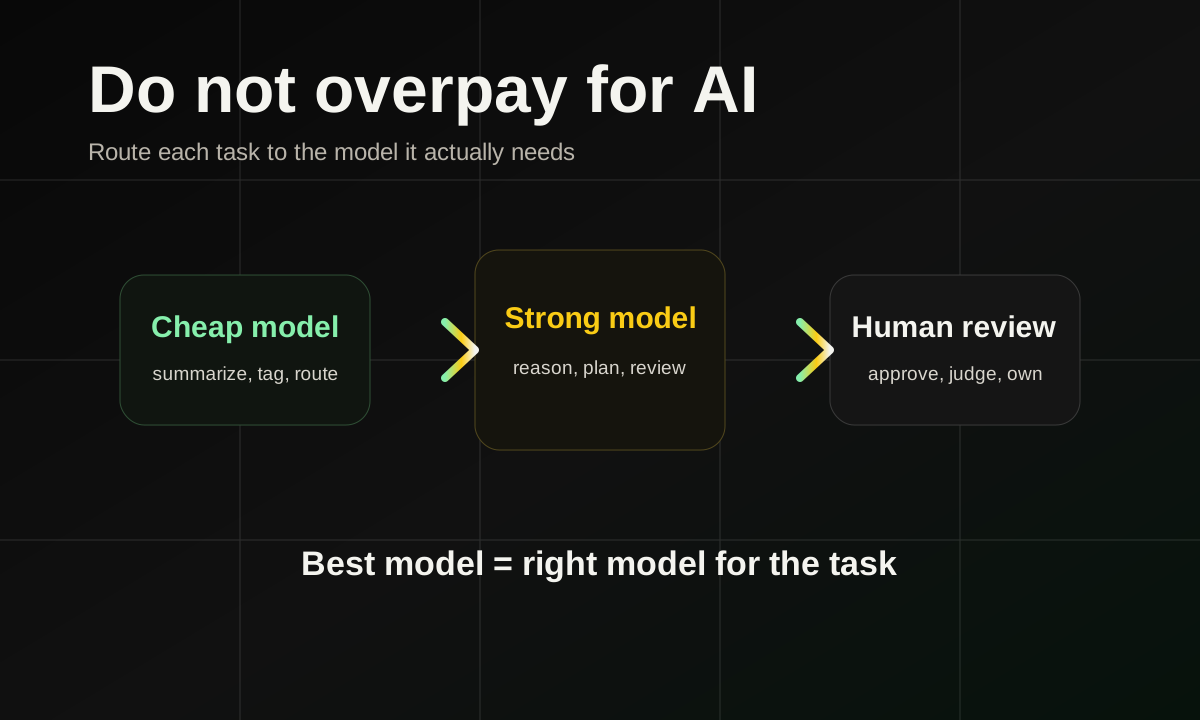
Think in three layers.
1. Cheap Model
Use for routine work:
- classify
- summarize
- rewrite
- extract
- route
- format
2. Strong Model
Use for judgment:
- plan
- reason
- compare options
- review outputs
- handle edge cases
3. Human Review
Use for accountability:
- approve final decisions
- check facts
- handle sensitive cases
- judge taste and context
This is how AI becomes affordable.
Not one expensive model doing everything. A stack where each layer does the right job.
How To Apply This
Before choosing a model, classify the task.
Use this prompt:
I want to use AI for this workflow:
+[describe workflow]

Break it into steps.
For each step, tell me whether I need:
- cheap model
- strong model
- human review

Explain why and show where I can save cost safely.
For business users:
Design a low-cost AI workflow for [task].
Use cheaper models for routine steps and a stronger model only where judgment is needed.
Include failure points and human review checks.
For developers:
Propose a model-routing strategy for this product feature.
Separate easy, medium, and high-risk requests.
Recommend which requests should use a small model, a frontier model, or human escalation.
What To Avoid
Do not downgrade everything just to save money.
Cheap models can fail when the task requires deep reasoning, rare knowledge, complex instructions, or careful judgment.
Also avoid using too many models without measuring quality. Routing only works if you track failures.
At minimum, measure:
- cost per task
- response quality
- user corrections
- hallucination rate
- human review time
- latency
The goal is not cheap AI. The goal is useful AI at the right cost.
Bottom Line
The future is not one model winning everything.
The future is model choice by task.
Use premium models where quality matters. Use cheaper models where repetition matters. Use humans where accountability matters.
That is how AI becomes practical for students, creators, founders, and businesses.
Sources used: Terminus-4B paper, Domain-adapted small language models paper, contract extraction small model paper, and ITPro on small language models.