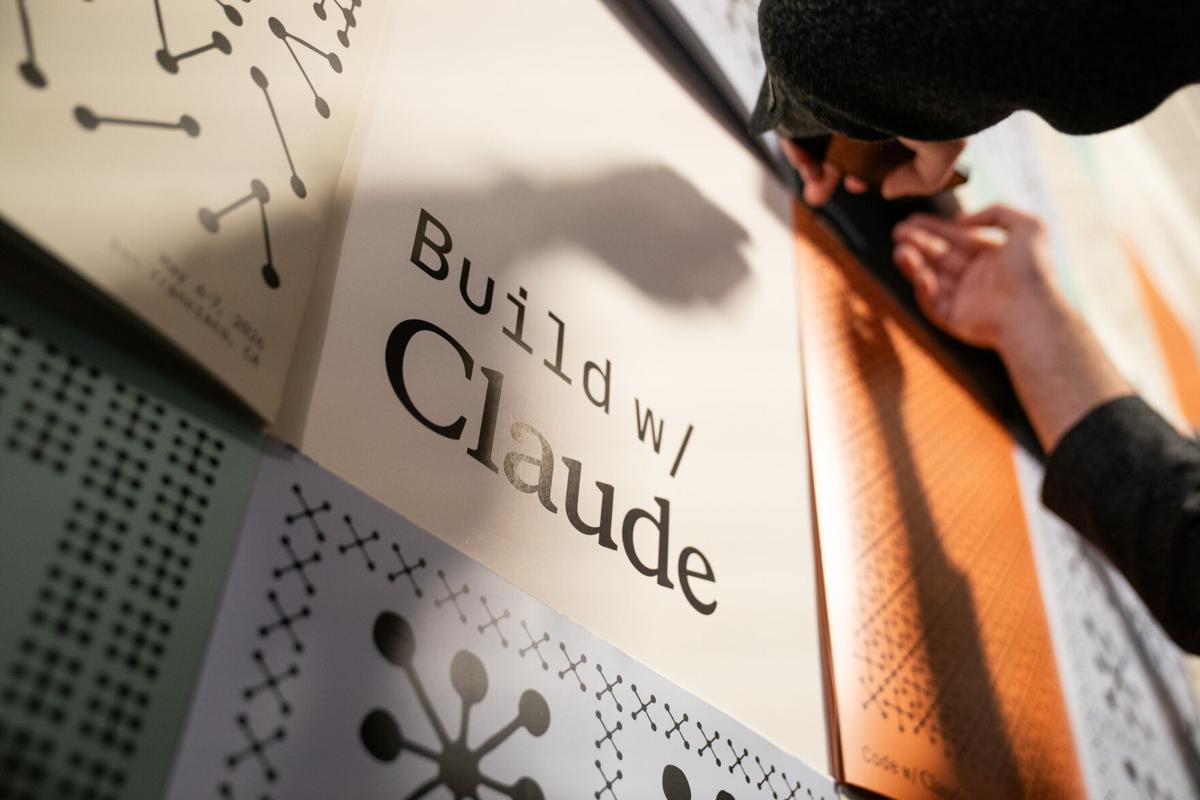
For months, developers have been running into the same wall: Claude was capable enough to automate real work, but the infrastructure to keep it running, learning, and scaling wasn't there yet. At Code with Claude San Francisco on May 6, 2026, Anthropic addressed exactly that. No new flagship model. Just the plumbing that makes agents production-ready.
That choice was deliberate, and it signals something important about where Anthropic is focused.
The Headline Nobody Expected: SpaceX
The biggest surprise of the day wasn't a feature. It was a compute deal.
Anthropic announced a partnership with SpaceX to use all of the compute capacity at Colossus 1, the Memphis, Tennessee data center housing over 220,000 NVIDIA GPUs, including H100, H200, and GB200 accelerators. That translates to more than 300 megawatts of new capacity, available within the month.
The immediate impact is tangible:
- Claude Code's five-hour rate limits are doubled across Pro, Max, Team, and Enterprise plans, effective May 6
- Peak-hours throttling is removed for Pro and Max accounts
- Claude Opus API rate limits raised considerably across tiers
This isn't the only compute deal Anthropic has in motion. The company also has a 5 GW agreement with Amazon (1 GW online by end of 2026), a 5 GW deal with Google and Broadcom (coming online 2027), a $30 billion Microsoft/NVIDIA Azure partnership, and a $50 billion infrastructure investment with Fluidstack. But unlike those, the SpaceX deal adds capacity now.
Anthropic also disclosed interest in developing orbital AI compute capacity with SpaceX, a longer-horizon ambition that, if real, would be an entirely different category of infrastructure.
The backdrop: API volume on the Anthropic platform is up 17x year-over-year. The capacity crunch wasn't theoretical.
Dreaming: Self-Improving Agents
The most conceptually interesting announcement was Dreaming, a new feature for Managed Agents, currently in research preview.
The concept: Claude agents can now review their own past sessions during off-hours, identify patterns they missed while working, and update long-term memory with those insights. Anthropic describes it as a "strong memory system for self-improving agents", a scheduled loop that surfaces recurring mistakes, preferred workflows, and team-level preferences that a single session would never catch.
The analogy to sleep is intentional. Context windows are finite. Important information degrades over long projects. Compaction handles a single conversation; Dreaming works across agents and sessions, giving teams a way to preserve institutional knowledge their AI workforce generates over time.
Users can run the process automatically or review and approve each memory change manually. Harvey, one early user, reported a sixfold increase in task completion rates after the feature surfaced file-type workarounds and tool-specific patterns from extended drafting sessions.
Dreaming is currently supported on Claude Opus 4.7 and Claude Sonnet 4.6, available via beta headers on the Managed Agents platform. It's billed at standard API token rates based on the volume of sessions processed.
Managed Agents: Three Features, Two Now Generally Available
Beyond Dreaming, Anthropic moved two previously previewed features into public beta:
Multi-Agent Orchestration allows a lead agent to decompose complex tasks and delegate to specialist subagents, with full visibility in the Claude Console. This is the architecture behind any serious long-horizon workflow, one agent planning, many agents executing.
Outcomes lets developers define explicit success criteria for tasks. A separate grader agent evaluates results against those benchmarks and retries if they don't meet the bar. In Anthropic's internal testing, it improved task success rates by up to 10 percentage points over standard prompting loops.
Together with Dreaming, these three features form a coherent agentic loop: delegate intelligently, evaluate rigorously, and improve over time.
The Advisor Strategy
One underrated announcement: the "advisor strategy", a pattern where Opus provides on-demand guidance to smaller, faster models running the actual workload.
The result: benchmark performance comparable to running Opus end-to-end, at a fraction of the cost. One customer, eve, achieved frontier-model quality at 5x lower cost by routing complex reasoning calls to Opus as an advisor while using Sonnet for execution.
This is a meaningful architectural pattern for anyone building production agents at scale. The cost curve changes substantially when you stop thinking of Opus as the primary model and start treating it as a consultant.
Claude Code: Three Surfaces, One SDK
Boris Cherny, Head of Claude Code, walked through the current Claude Code surface lineup:
- CLI, full control, the original interface, most customizable
- IDE integration, same agents, with a UI to follow code changes in real time
- Claude Code on Desktop, new; a full-screen GUI with rich output, images, and full-screen preview
Critically, both IDE and Desktop are built on the same Claude Agent SDK available to external developers, meaning whatever Anthropic ships, third-party tooling can build on the same foundation.
Two additional capabilities also shipped:
- Code Review, now used by every team at Anthropic internally
- Remote Agents, lets developers control their laptop's Claude Code instance from their phone
What Wasn't Announced
No new model. Ami Vora was explicit: "Today is about how we are making our products work better for you."
That's a notable choice. Anthropic could have used a developer conference to launch something headline-grabbing. Instead, the company bet that infrastructure, capacity, and agentic tooling are what developers actually need right now.
Given that API volume has grown 17x in a year, they may be right.
Why This Matters
The theme running through May 6 isn't hard to identify: Anthropic is building for long-running, multi-agent, self-improving workflows, not chat sessions. Dreaming, Outcomes, Multi-Agent Orchestration, and the Advisor Strategy all point in the same direction.
The SpaceX deal is the physical manifestation of that bet. You don't double rate limits and absorb 300 megawatts of new capacity unless you expect agents to run for hours, not seconds.
The next stops are London on May 19 and Tokyo on June 10. Given the pattern, expect each to build on the agentic infrastructure story rather than pivot to consumer announcements.
If you're building on Claude today, the practical takeaways are:
- Capacity constraints just got meaningfully better, run longer, parallelize more
- Dreaming is worth requesting beta access to if you have long-running workflows with accumulated session history
- The Advisor Strategy is an immediate cost optimization, audit where you're using Opus end-to-end and consider a Sonnet + Opus advisor split
- Multi-Agent Orchestration hitting public beta means the tooling is stabilizing, now is the time to design around it, not wait
The agentic era isn't a vision anymore. It's becoming infrastructure.