The top 5 stories by email, daily.Subscribe
Sun, Nov 151 / 21
01Model release

Alibaba Launches Qwen4-Max, a 2.4 Trillion Parameter Flagship With a 1M Token Context Window and Lower Prices (opens the post on X)

📢 Meet Qwen4-Max, your new AI teammate for work, creativity, and discovery! Qwen4-Max is built on a new MoE architecture with native vision and a 1M-token context window. Highlights: - Outperforms Qwen3.8-Max with up to ~50% fewer tokens, while average cost per task drops over 60% in our internal evaluation. - Advances real-world productivity through greater proficiency with professional tools, stronger long-horizon execution, and higher-quality deliverables. - Handles real tasks, including 3D modeling, game development, manufacturing, finance, law, healthcare, and frontier scientific discovery. - $1.5/M tokens for input, $4.5/M tokens for output, and $0.075/M tokens for implicit caching — all lower than Qwen3.8-Max, with implicit caching down by 70%. The API is live on QwenCloud. You can also try Qwen4-Max on Qwen Studio, QwenWork and Qoder. Start building today! 🚀 - Blog: t.co/AuiWxugjE6 - API: t.co/aS1QEkS8nu - Token Plan: t.co/YRvcGdB9Bv More to come! The open weights of smaller Qwen4 models will be released. Stay tuned. 👀


A grid of 16 bar charts comparing Qwen4-Max in blue with Qwen3.8-Max-0902, Opus 5.5, GPT6.1-Sol, GPT6-Astra and Kimi K3.1 on benchmarks including DeepSWE, CodeArena, Terminal-Bench 4.0, Agents' Last Exam and Humanity's Last Exam.
3 sources posting
02Research

OpenAI Opens a Science Blog as Physicist Nathaniel Craig Says GPT-6 Astra Helped Build a Candidate Lattice Definition of the Standard Model (opens the post on X)

Physicist Nathaniel Craig shares how he worked with GPT-6 Astra to develop a candidate lattice definition of the Standard Model. It’s the first post on our new science blog:

2 sources posting
03Business

Financial Times: Jensen Huang Discusses a Comeback as Nvidia CEO with Allies (opens the post on X)

4 sources posting
04Policy

Kobeissi Letter, Citing the FT: Congress Prepares Tighter AI Chip Export Controls After the Nvidia Scandal (opens the post on X)

BREAKING: US Congress is preparing to pass tighter AI chip export controls following the Nvidia, $NVDA, scandal, per FT. Details include: 1. Several bills are aiming to curb sales of sensitive chips outside of the US. 2. The bills will also give Congress the ability to review and potentially block sales already approved by the Trump Administration 3. Democrats and Republicans have both thrown support behind the bills It appears more regulation is on the way.

2 sources posting
05Policy

WSJ, via Reuters: Trump Administration Plans to Name Nvidia, OpenAI, Anthropic and Others US AI 'National Champions' (opens the post on X)

Trump administration to name Nvidia, other AI firms as US 'national champions', WSJ reports

3 sources posting
06Policy

Reuters: Bessent Says Nvidia Must Go Outside the Company to Find a New CEO (opens the post on X)

5 sources posting
07Policy

Grok Text Watermarking Is Now Off by Default in the SpaceXSI API (opens the post on X)

Grok's text watermarking is now off by default in the SpaceXSI API. Elon Musk confirmed it and went further. He says text watermarking with Grok is only on where the law requires it or a user asks for it. So if you build on Grok, your output won't carry a hidden watermark unless you switch it on or a law requires one.

08Hardware

Ming Chi Kuo: OpenAI and Anthropic Orders Give Google TPU Shipments Visibility to 2029 (opens the post on X)

Google TPU update: New OpenAI and Anthropic orders extend shipment visibility to 2029; v10 lineup overhauled (now Quillfish); MediaTek and Broadcom lead as the top suppliers to watch Key takeaways from my latest industry survey and research conclusions: 1. Order visibility and shipment plans: Strong new orders from OpenAI and Anthropic have extended Google TPU shipment visibility to 2029, ahead of Nvidia GPUs and other AI ASICs (mostly 4Q27–2Q28). (1) From 2028, v9 will become the mainstay of Google’s own compute buildout, so v8-series orders (8t / 8i or their design variants) can be viewed as coming from OpenAI and Anthropic. (2) Combined 2028–2029 demand: about 12M units for OpenAI (8t, designed by MediaTek) and about 14M for Anthropic (8i, designed by Broadcom), with both growing year over year. OpenAI buys outright, while Anthropic uses a mix of leasing and outright purchases. (3) Given supply chain constraints, more reasonable TPU shipment estimates for 2027–2029 are 8–9M, 14–15M, and 16–18M units, respectively. The market broadly expects AI capex to peak in 2028, yet this plan shows TPU shipments still growing in 2029, driven by direct orders from AI service leaders OpenAI and Anthropic. 2. v10 lineup and supply chain changes: v10 has changed from Icefish and Merope / Bladerunner to Quillfish, with mass production expected in 2029. MediaTek has won the design service order. (1) Icefish is now v11, with mass production expected in 2030 and the design service order also going to MediaTek. Merope has lower visibility: no supplier has been chosen, and it may be canceled. (2) MediaTek will be the sole supplier for v9 (Humufish & Triggerfish) and v10 (Quillfish), accounting for about 45–50%, 50–55%, and 55–60% of total TPU supply in 2027–2029, respectively. TPU’s contribution to its revenue and profit should rise each year. (3) From v9 onward, all new TPUs use Intel’s EMIB-T advanced packaging. Given limited initial production capacity, the v8 series should remain the bulk of TPU shipments through 2029. v8 is expected to be the main source of TPU profit growth for MediaTek and Broadcom over the next few years, thanks to significant accumulated learning-curve benefits and the fact that both handle procurement of key components and materials. 3. Market attention and supplier outlook: Recent events should raise and sustain market attention on Google TPU, with key design service providers MediaTek and Broadcom likely to be the supply chain’s top focus. (1) Uncertainty over Nvidia’s CEO succession helps Google in discussing post-2028 long-term plans with customers. OpenAI and Anthropic are both key TPU customers, so their IPOs should also raise and sustain attention on TPU, and MediaTek and Broadcom are the suppliers the market most readily associates with it. (2) MediaTek is clearly the biggest TPU winner of the next few years. Its position as sole design supplier from v9 onward, together with a supply share that rises each year alongside TPU shipments, will expand its TPU revenue. The high-margin 8t series, with shipment visibility through 2029, is a key profit source. (3) Because Broadcom leads the 8i design, its gross margin is even higher than the 8t’s, supporting Broadcom’s profit growth. Note, however, that Broadcom’s focus over the next few years will be non-TPU XPU and AI networking chip orders, with non-TPU revenue expected to surpass TPU revenue as early as 2027.

09Product

Mark Gurman: Apple's Smart Glasses, Planned for Next Year, Will Lead With Siri AI Control of iPhone Apps (opens the post on X)

NEW Power On: Apple’s next big product — smart glasses planned next year — will offer Siri AI app integrations as its flagship feature. The idea: Book an Uber, reserve a table or order a coffee from your Apple Glasses — with apps running on paired iPhone.

1 source posting
10Product

Varun Mohan Says Antigravity Doubled Context for Argon, Carbon and Hydrogen (opens the post on X)

We’re doubling the context window for Argon, Carbon, and Hydrogen in Antigravity. Lots of work to make this happen but you should now see compaction go down by 3.5x per user turn!

11Business

The Information: AMD and Broadcom Cannot Match the Credit Guarantees Nvidia Gave AI Data Center Builders (opens the post on X)

Semiconductor executives say AMD and Broadcom can't take on the huge credit guarantees Nvidia has given cloud providers and data center developers, which leaves a gap if Nvidia pulls back. Full story:

2 sources posting
12Infrastructure

Zerohedge, Citing JPMorgan: 3.8GW of Malaysia's Data Center Pipeline Is Tied to Chinese Operators (opens the post on X)

"Déjà Vu": JPMorgan Finds 3.8GW Of Malaysia's Data Center Pipeline Tied To Chinese Operators As Washington Moves To Shut The Backdoor

1 source posting
13Infrastructure

Zerohedge: Blackstone's QTS Raises Only $300 Million of an $800 Million Data Center Debt Sale (opens the post on X)

First Junk, Now Investment Grade: Blackstone's Own Data Center Giant Can't Sell $800 Million Of Debt

1 source posting
14Funding

unusual_whales Cites a Hill Analysis That an Anthropic IPO Could Make About 4,250 Employees Millionaires (opens the post on X)

Anthropic’s IPO could make about 4,250 of its 5,300 employees millionaires, per an analysis by financial platform Hill, including roughly 50 worth more than $100 million each. The estimate assumes a $1.5 trillion valuation, above the roughly $1 trillion Anthropic is now targeting.

1 source posting
15Research

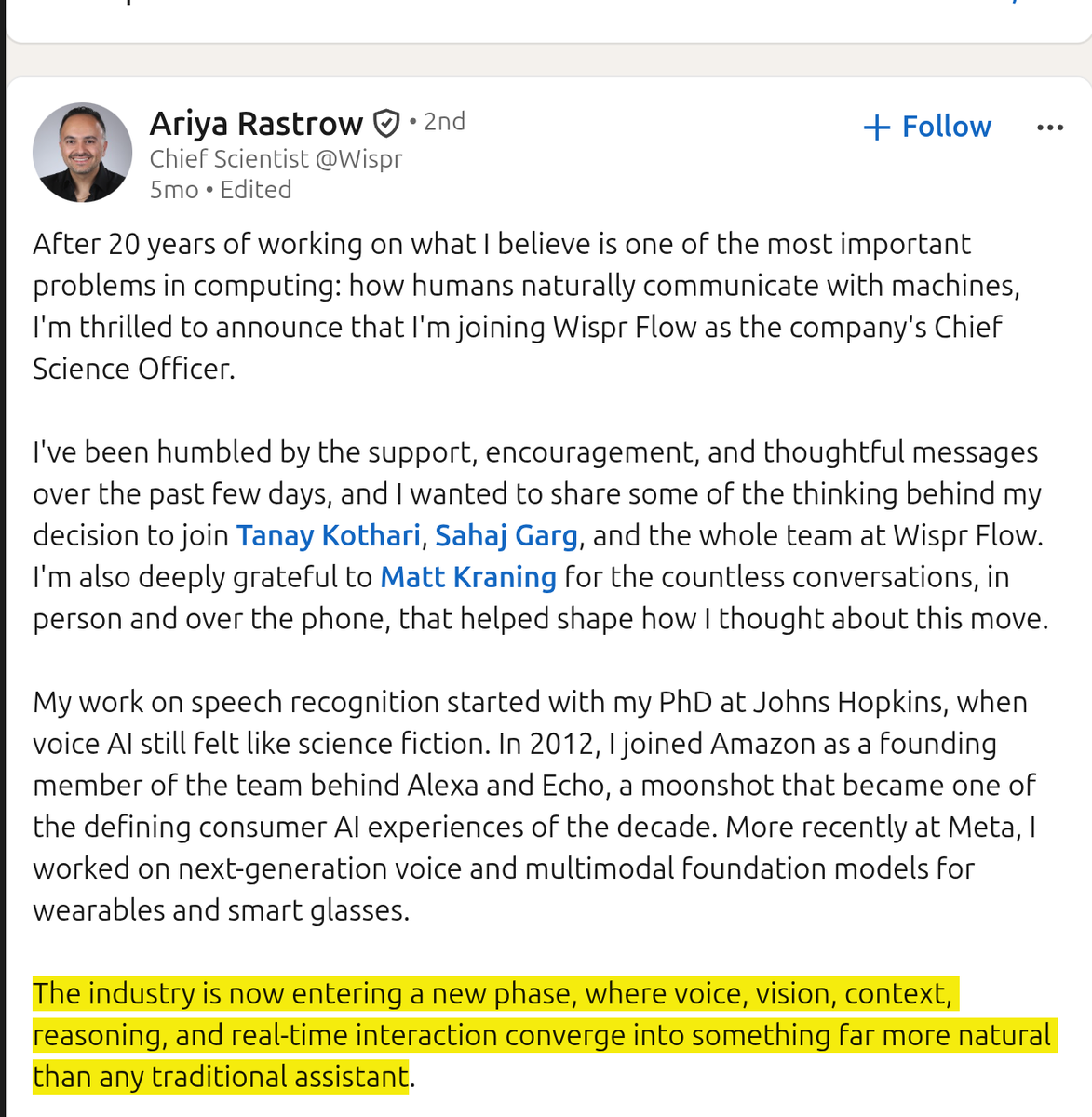
Rohan Paul: WisprFlow Hires Founding Alexa Scientist Ariya Rastrow and Moves to Speech Models It Trains Itself (opens the post on X)

The keyboard was a workaround for machines that couldn’t hear. Machines that hear make it optional. WisprFlow recently hired Ariya Rastrow (founding Alexa scientist) as chief science officer and moved from rented speech engines to models it trains itself. Hard to find a better fit for a speech lab than someone who scaled Alexa’s speech team. Canto 1, his lab’s first model, was built to cut how often people edit dictated text, so Wispr trained it on noisy real-world dictations and tuned it to each user’s vocabulary and names. And this is a hard test, unlike many, because Speech recognition was long tested on clean, read-aloud audio, but the hard problem is a cheap laptop mic in a room where someone else is talking. On about 10 hours of real Flow dictations from more than 2,300 speakers, it posted a 3.4% word error rate, lower than all competing models that Wispr tested. Typing gives you feedback on every keystroke, while speech makes you wait until the end of a sentence to see what the machine heard, so speed counts as much as accuracy. Since launch, dictations that take more than 1 second to appear are down 54%. Its training runs through pretraining, supervised fine-tuning and reinforcement learning with GRPO, the same stages used for large language models. The reinforcement learning stage uses corrections from Flow users who opted in to share data. When someone fixes a dictated word, Wispr checks how the audio aligns with the text and how the edit is shaped. A misheard word gets folded back into the training reference, and a plain rewrite of the sentence gets ignored.

A LinkedIn post by Ariya Rastrow, Chief Scientist at Wispr, announcing that he is joining Wispr Flow as chief science officer and describing his PhD at Johns Hopkins and his founding role on Amazon's Alexa and Echo team.A bar chart titled How often a dictation needed a fix, showing Wispr Flow lowest at 20.6 percent, then Gemini at 24.2 percent, with Apple Dictation highest at 65.4 percent, from the Voice Arena Dictation Bench.
1 source posting
16Product

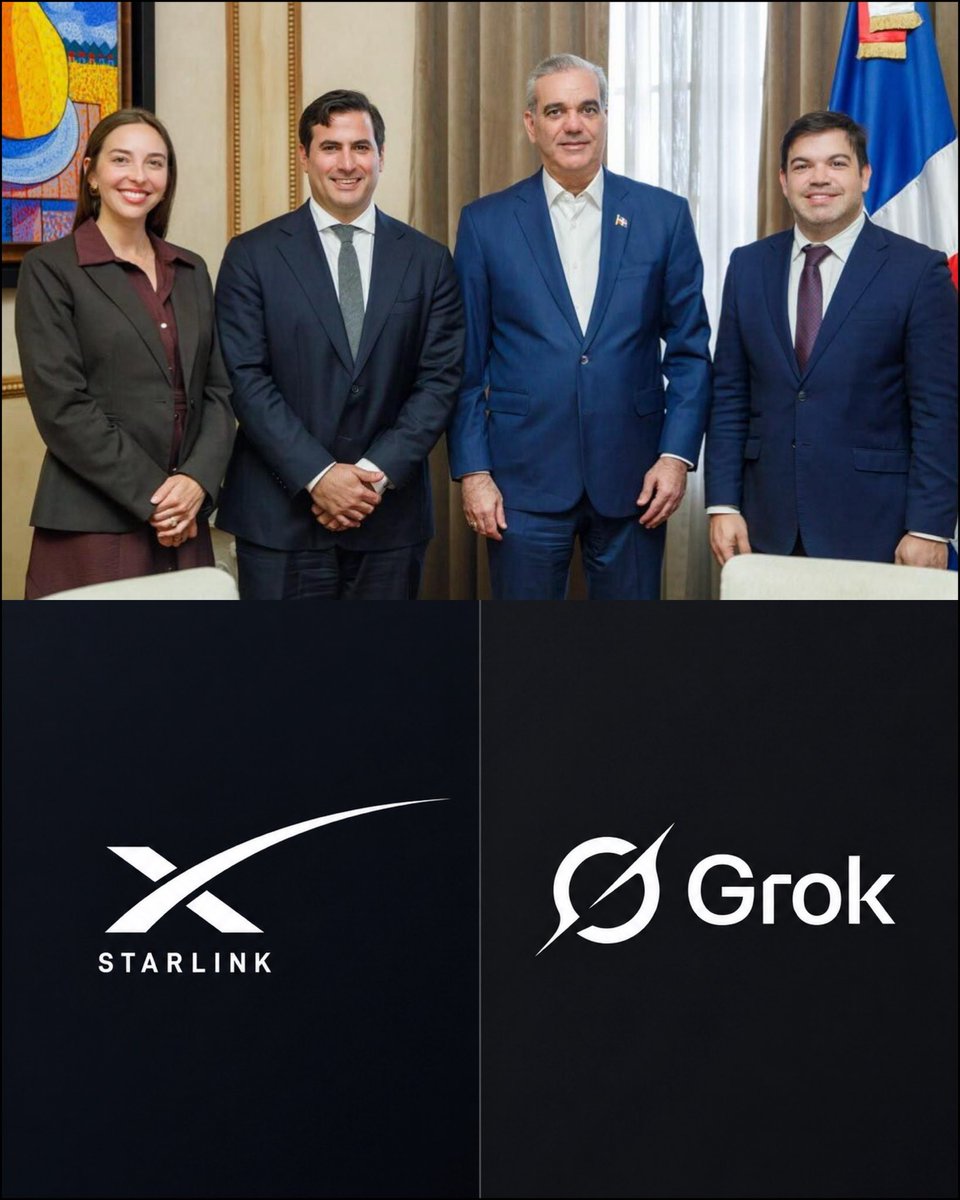
DogeDesigner: Dominican Republic Explores Grok Tutor for Schools as President Abinader Meets SpaceX (opens the post on X)

BREAKING: Dominican Republic Government advances plans to expand Starlink connectivity and explores Grok for education. 🇩🇴 President Luis Abinader met with SpaceX executives and the Instituto Tecnológico de las Américas (ITLA) to discuss the initiatives: • More than 50,000 Starlink antennas are already installed across the country. • Starlink is already benefiting 1,608 students at ITLA’s Pedernales and Cotuí campuses. • Further expansion would bring internet to communities and schools where traditional services are limited or unavailable. • Grok Tutor is being considered for personalized learning support, helping students develop reasoning and critical thinking with teacher supervision. • Its potential integration would support RD Inteligente, a Government program aiming to train one million Dominicans in AI.

Four people in business clothes stand together in an ornate office with a Dominican flag, above two black panels showing the Starlink and Grok logos.
1 source posting
17Business

Cartoons On The Moon: Paramount Skydance's David Ellison Bets on AI to Cut Costs Under $87 Billion of Debt (opens the post on X)

Paramount Skydance optará por el uso de IA para ahorrar costos en su deuda multimillonaria de 87 mil millones de dólares. En palabras del CEO, David Ellison, la IA permitirá que la producción cinematográfica sea más rápida y barata.

The Warner Bros. shield logo above the Paramount mountain logo on a dark blue background.A blue icon of the letters AI inside a rounded square with sparkle shapes, on a white background.
1 source posting
18Opinion

Chubby, Secondhand: An Anthropic Researcher Says Broadly Superhuman AI Could Be About 1.3 Years Away (opens the post on X)

Now we are talking: An Anthropic researcher says broadly superhuman AI could be just 1.3 years away.

A video frame from Chubby's post about an Anthropic researcher discussing a superhuman AI timeline.
19Opinion

SemiAnalysis Lays Out the Devil's Advocate Case for Letting China Rent American Compute (opens the post on X)

The devil’s advocate case for letting China rent American compute. “If China has access to compute outside of China, it’s paying humongous margin dollars to the US ecosystem. Nvidia makes about $7 million of profit on every megawatt deployed. The cloud provider makes another $7 to 10 million at today’s pricing.” “If ByteDance wants to compete with Meta on video recommendation globally, and you don’t let it buy the chips but you do let it rent them, Meta potentially has a fourth of the cost of compute.” “Application-layer companies running on open models add up to well north of $10 billion in ARR. DeepSeek makes less than Baseten and Fireworks do serving its models. America is making so much money off Chinese models.”

A man in a dark shirt rests his chin on his hand in a video frame, beside an on screen card about the Remote Access Security Act on a dark background with a SemiAnalysis logo.
1 source posting
20Opinion

Unverified: Tim Sweeney Says the Huang Reports Backtracked and Appear to Trace Back to a Single Rival Big Tech Lobbyist (opens the post on X)

The articles backtracked from their original incendiary, and now clearly false, claims to something more like "Jensen did lawful things that powerful people didn't like". It still appears the original claims came from a single competing Big Tech lobbyist. The reporting successfully disrupted corporate governance processes, with a running cost of $1.8 trillion in losses to American pension funds and shareholders. Here's what I fear is being lost in these articles: The proper interface between government and private citizens and their corporations is rule of law. Laws are passed, and if wrongdoing as alleged, then there's due process: an investigation followed by facts and evidence presented in open court. Due process should happen here: let the facts come out whole, and not as a trickle of dubious claims. Press takedowns full of sketchily sourced claims and backtracking narratives are not the way. It's what we see outside of the free world, and is no model for The United States of America. In particular, if the Jensen takedown succeeds on the basis of these journalistic failings, which is not by any means certain as Sam Altman's case shows, then it foreshadows an economically and institutionally ruinous new playbook to be adopted with no end in sight. Imagine a weekly stream of takedowns emerging from opportunistic alignments between corporate lobbyists and political interests which, given the new partisan split between the executive and legislative branches, will attack in all directions, undermining not only the US economy but American leadership in the world. I hope cooler heads prevail this coming week as they did not on Thursday November 12. And I urge anyone who happened to oppose Jensen, open models, and the underlying trade policies in question, to recognize that this isn't a win for "team regulation". It's a change in the game from a transparent rules-based one to a sinister new form centered around politicans and lobbyists.

1 source posting
21Product

Grok Bot Cuts a Highlight Reel From the Starship Flight 15 Livestream (opens the post on X)

Grok Bot made this Starship Flight 15 highlight reel for me. 🚀 It downloaded the 23-hour livestream, picked out the best moments, edited the clips together, added effects and music, all so quickly. You don’t need a video editor anymore. Just ask Grok Bot.

A dark night sky with a small bright point of light, from a Grok Bot highlight reel of Starship Flight 15.

You're caught up.

That was everything from Sunday, November 15. The next deck lands tomorrow.

Scanned , 141 sources