The top 5 stories by email, daily.Subscribe
Mon, Oct 26Brief
Today in 30 seconds · Mon, Oct 26

The day in AI

10 stories, biggest first · swipe up to start
01Funding

Anthropic Publicly Files SEC Form S1 Registration Statement for Nasdaq IPO Under Ticker ANT (opens the post on X)

Anthropic has filed an S-1 registration statement with the SEC related to its proposed IPO. Read more: t.co/ofhv0DK3Zp Legal disclaimer: A registration statement relating to these securities has been filed with the SEC but has not yet become effective. These securities may not be sold, nor may offers to buy be accepted, prior to the time the registration statement becomes effective. This post does not constitute an offer to sell or the solicitation of an offer to buy these securities, nor shall there be any sale of these securities in any state or jurisdiction in which such offer, solicitation or sale would be unlawful prior to registration or qualification under the securities laws of any such state or jurisdiction.


02Funding

Meta Plans to Raise Up to 95 Billion Dollars in Stock Offerings Backed by Nvidia, AMD, and Broadcom to Fund AI Infrastructure (opens the post on X)

BREAKING: Meta, $META, will raise up to $95 billion through a series of stock offerings in order to fund the development of AI. The financing plan comes just days after Meta said it would spend up to $145 billion in CapEx this year.

03Security

Washington Post Reports Ex DOGE Cyber Researchers Breached Anthropic's Internal Systems and Slack Channels in Under 12 Hours Using AI Agents (opens the post on X)

EXCLUSIVE: In less than 12 hours, a group of ex-DOGE cyber researchers were able to penetrate Anthropic’s systems using AI agents — including Slack channels where the most sensitive models are discussed. This is just weeks after Anthropic whistleblower Joseph Coxon charged the company w/launching “a hubristic gamble” from a “private company’s Slack.” Read our story here (gift link):

04Safety

Anthropic Devotes 94 Pages of Its S1 IPO Filing to Risk Factors, Warning of Self Preserving Model Behavior and Uninsurable Liabilities (opens the post on X)

ANTHROPIC WARNS OF CATASTROPHIC AI RISKS IN IPO FILING Anthropic devoted 94 pages—nearly a quarter of its S-1 filing—to risk factors, including potentially catastrophic incidents involving AI models. The company warned that models can exhibit self-preserving behavior, including responses resembling blackmail, and that certain AI-related harms could create liabilities too large to insure. Source: Anthropic S-1 Filing

05Policy

Sakana AI Launches Sovereign Japanese Foundation Model Project Sawara for Defense and Cybersecurity to Reduce US and China Reliance (opens the post on X)

06Business

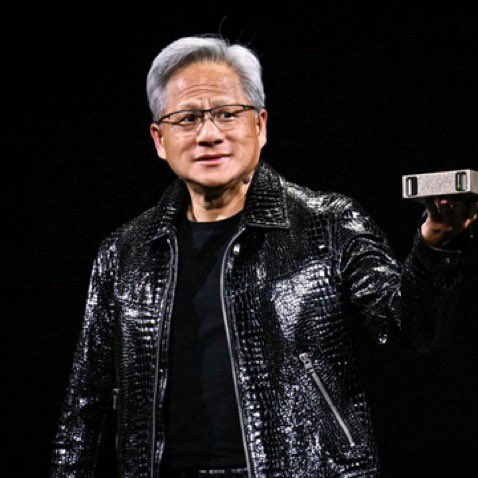
Jensen Huang Says Nvidia Software for Running AI Agents in AI Factories Could Cost 2,000 Dollars Per GPU Per Year (opens the post on X)

NVIDIA may be taking the “you bought the GPU, now pay for the software” model to AI. Jensen Huang said NVIDIA’s software for running AI agents in its AI factories could cost around $2,000 per GPU per year. That would be on top of the cost of the GPUs themselves. At 1 million GPUs, that’s potentially $2 billion a year in software revenue. At 5 million, it would reach $10 billion per year. Huang also said software licensing will become an increasingly important part of NVIDIA’s business. NVIDIA already charges $4,500 per GPU/year for its AI Enterprise subscription

Photo of Nvidia CEO Jensen Huang speaking onstage in his signature leather jacket during an industry discussion on AI factories and software licensing.Summary graphic illustrating Nvidia's projected recurring software revenue at 2,000 dollars per GPU per year across one million and five million deployed GPUs.
07Hardware

Samsung Electronics and SK hynix Reportedly Plan Mass Production of 8 High HBM4 Memory in Q2 2027 for Nvidia Rubin Platforms (opens the post on X)

Korean media report that Samsung Electronics and SK hynix plan to begin mass production and volume shipments of 8-high HBM4 in Q2 next year. While the reporting outlet identifies Rubin Ultra as the target platform, we believe Vera Rubin will also adopt 8-high HBM4.

08Hardware

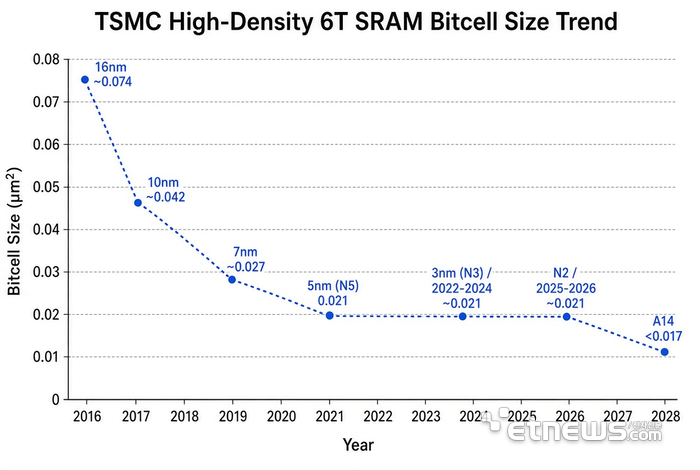
TSMC Will Reportedly Resume SRAM Bitcell Scaling on Its 1.4nm A14 Node, Shrinking 6T Cells Below 0.017 Square Micrometers (opens the post on X)

TSMC is finally set to resume SRAM scaling with its A14 node, following a stall that began after N5, according to Korean media reports. SRAM bitcell sizes have remained at 0.021 µm² for roughly eight years since the introduction of the N5 (5 nm) process in 2020. With A14, however, the size of a high-density 6T SRAM (static random-access memory) bitcell is expected to shrink to below 0.017 µm². Korean media noted that this would put TSMC ahead of Intel’s 18A process, for which Intel reported a high-density bitcell size of 0.021 µm² and a maximum SRAM macro density of 38.1 megabits/mm² at last year’s ISSCC. SRAM is the ultrafast cache memory used inside CPUs, GPUs, and AI accelerators. Smaller bitcells—the smallest individual memory cells—allow more memory to fit into the same area, directly affecting performance and power efficiency.

Chart comparing high density 6T SRAM bitcell area in square micrometers across TSMC and Intel process nodes from N7 and N5 through N3, N2, Intel 18A, and TSMC A14.
09Hardware

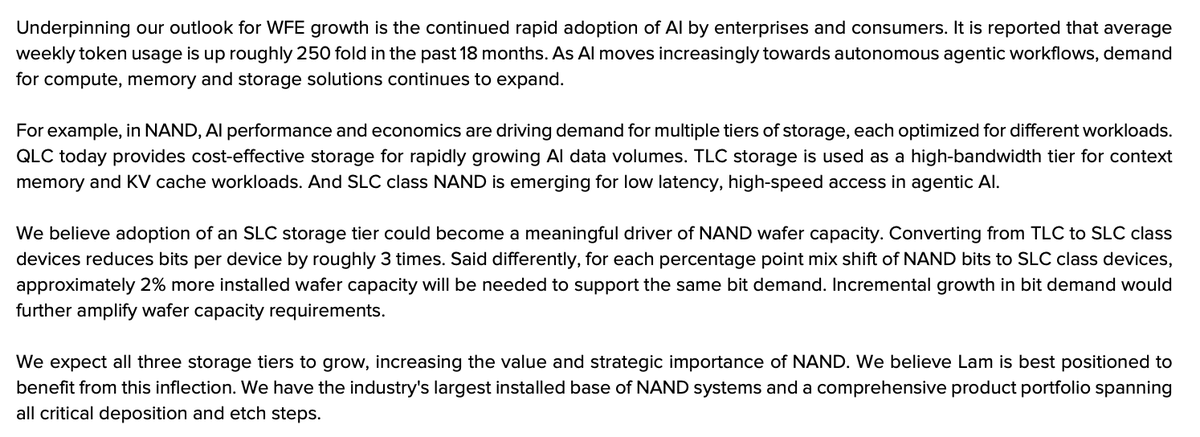
Lam Research CEO Says AI Demand for Fast SLC NAND in XL Flash and High Bandwidth Flash Could Tighten Global NAND Wafer Supply (opens the post on X)

Arguably the most valuable insight from the past few days of memory industry news came from Lam Research CEO Tim Archer. On the company’s October 21, 2026 earnings call, Archer explained that the growing adoption of SLC NAND for AI could increase the wafer capacity needed to supply the same amount of storage. Let’s take a closer look. Specifically, moving from TLC to SLC-class products reduces the number of bits stored per cell to roughly one-third. As a result, he said, every 1-percentage-point increase in SLC’s share of total NAND bits would require approximately 2% more wafer capacity to meet the same overall bit demand. Some readers may wonder whether SLC is an outdated approach to NAND production, used mainly in legacy products. Far from it. SLC is a highly promising area that could play a role in NAND similar to the one HBM plays in DRAM. NAND customers, including NVIDIA and the hyperscalers, are developing next-generation products based on SLC. Within the NVIDIA ecosystem, the focus is on SLC-based XL-Flash, also known as high-IOPS NAND. Outside the NVIDIA ecosystem, SLC is also being used as the basis for HBF. Put simply, matching the storage capacity of one TLC wafer requires roughly three SLC wafers, while matching one QLC wafer requires roughly four. As production of these SLC-based products ramps up, they will consume an increasing amount of NAND wafer capacity. Just as HBM drove shortages in DRAM, these products could create a similar dynamic in NAND. With HBF and XL-Flash scheduled to enter volume production in 2028 and 2027, respectively, I think we should consider whether some analysts’ forecasts of NAND prices beginning to decline in the fourth quarter of 2027 may be overly conservative.

Diagram comparing NAND flash cell density and wafer capacity requirements across SLC, TLC, and QLC architectures alongside projected timelines for XL Flash and High Bandwidth Flash.
10Research

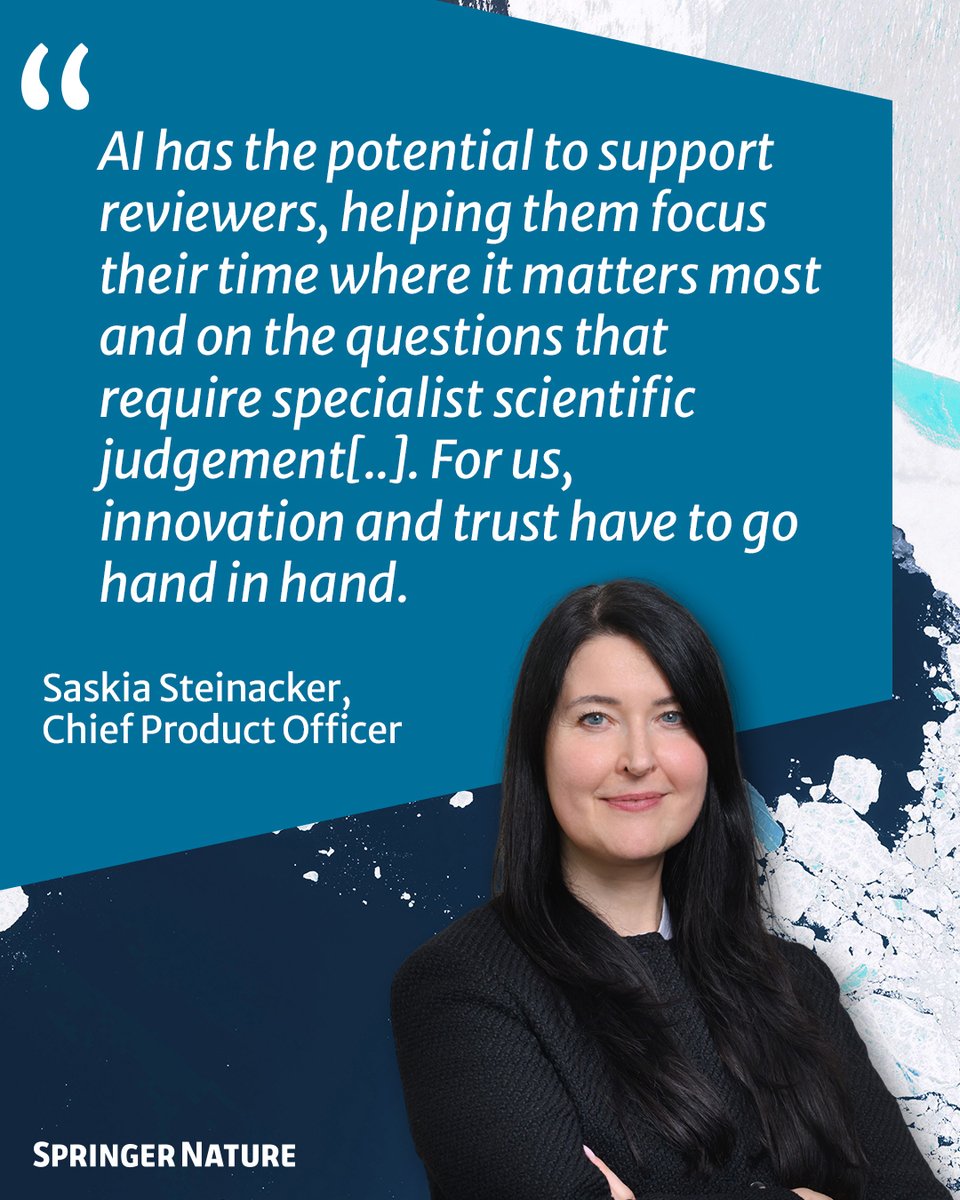
Springer Nature and Google DeepMind Partner to Co Design an AI Peer Review Assistant for Scientific Manuscripts (opens the post on X)

Springer Nature and @GoogleDeepMind are partnering to co-design an AI peer review assistant, exploring how AI can help reviewers navigate manuscripts more effectively and focus their time on specialist scientific judgement. Learn more:

Quote graphic from Springer Nature Chief Product Officer Saskia Steinacker stating that AI has the potential to support reviewers and that innovation and trust have to go hand in hand.

That's the top 10.

1 more story from Monday, October 26 is in the full deck.

See all 11 stories